

In the previous article, we explained how to win a game of Iron Triangle. This article focuses on the Sequence of Play and the different decks and cards used during the game.

Sequence of Play
The game is played over three rounds. In each round, players alternate turns, starting with the VC.
On a player’s turn, they play two cards onto any of the three current Operations. These correspond to the three region tracks: Warzone C, Warzone D, and the Iron Triangle.
After completing their turn, a player may discard one card from their hand and then draw cards back up to their current hand size.
Each player takes four turns per round, playing a total of eight cards to the Operations. Once both players have completed all of their turns, VC and U.S. Strength is compared across all three Operations. Rewards for winning Operations are then applied to the relevant regional control tracks and map spaces.
All three Operation cards are discarded, and the next set of three Operations is revealed from the deck, beginning the next round.
Hand Sizes
Hand sizes differ by faction. The VC begin the game with seven cards, but their hand size may be reduced through Attrition. The U.S. start with six cards, with their hand size increasing or decreasing based on regional Stability.
Operations
Anatomy of an Operation Card

How the Operation Deck Works
Each region in the game has its own Operation deck. At the start of a round:
- One Operation card from each region is revealed.
- These revealed cards form the Operations that players will fight over during the round.
- Players commit cards to these Operations, and the highest total strength wins that Operation.
This creates simultaneous contests across multiple regions, each with its own stakes.
Determining the Winner of an Operation
At the end of a round, all face-down VC cards are revealed.
An Operation is won by:
- Comparing total strength played by each player.
- If one player has higher strength, they win the Operation.
- If, and only if there is a tie, the players check the control track for that region:
- The player who currently controls the region gets +1 strength.
- Players that have a base adjacent to the control marker, gain an additional +2 strength.
- These bonuses break the tie.
Rewards and Bonus Thresholds
Each operation card shows two reward tiers:
- Standard reward — gained by simply winning the Operation.
- Bonus reward — gained only if the victory is decisive.
The card shows a bonus threshold, such as:
- “Bonus at strength differential of 4+”
This means:
- If you win by 4 or more strength, you gain both the standard reward and the bonus reward.
- If you win by less than the threshold, you gain only the standard reward.
This encourages players to consider whether to commit extra strength for a bigger payoff or commit a card to mitigate enemy rewards, even if they are still going to lose that Operation.
VC Card Anatomy

Attrition Symbol
The Attrition symbol represents the size of a unit and therefore the number of potential casualties the U.S. player can inflict when targeting these cards while they are face‑up.
Card State
This icon indicates whether the card may be played face‑up, face‑down, or in either state.
If a card can be played face‑down, the VC player may choose to deploy it in a tunnelled or concealed position, depending on the orientation of the face‑down card. This gives the VC player tactical flexibility:
- They can play a card face‑up to take its action immediately.
- They can conceal or tunnel a card to reveal it later in the round.
- They may also keep a card hidden until the end of the round, where it can influence the outcome of an Operation.
- Certain cards, such as Booby Traps and Ambushes, can be used to mislead the U.S. player into revealing them and suffering negative effects.
Actions
A card’s action can only be taken when the card is played face‑up or revealed during the round. Cards revealed only at the end of the round, when determining Operation outcomes, cannot perform actions at that stage.
Examples of VC Cards:

Ambush
Ambush cards may be played either face‑up or face‑down. When triggered, the VC player must reveal enough Attrition symbols to eliminate a US card with Strength equal to or lower than the total symbols shown. This creates a calculated gamble: revealing Attrition symbols can deliver a decisive strike, but it also exposes units which the US player may later exploit.

NVA Support
NVA Support cards may be played face‑up or face‑down. They carry higher Strength than standard VC units, reflecting the better‑equipped North Vietnamese Army forces. However, they also contain more Attrition symbols. This duality gives the VC player a powerful tool for winning Operations, while simultaneously increasing the US player’s opportunities to pursue their attrition‑based objectives.
U.S. Deck
All cards in the U.S. deck are played face‑up. The U.S. player’s objective is to restrict VC movement, locate hidden units, reveal their positions, and launch attacks. By rotating and flipping VC cards, the U.S. player aims to expose and target Attrition symbols.
Refugee Symbols

Some destructive U.S cards have refugee symbols. These cards represent actions which the U.S. take when they want to disrupt VC supply by displacing the local population.
Examples of U.S Cards
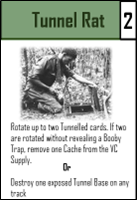
Tunnel Rats
The U.S. player has access to Tunnel Rat units, whose abilities can only be used against Tunnelled VC cards. When activated, a Tunnel Rat rotates one Tunnelled card, representing U.S. forces flushing the VC out of their underground network and forcing them back into the jungle.
If this rotation reveals a Booby Trap, the Tunnel Rat is immediately removed and placed in the discard pile, reflecting the dangers of navigating the tunnel systems.
If the rotation instead reveals a non–Booby Trap, the U.S. player may choose to push their luck and attempt a second rotation. If successful, they not only expose the VC further but also remove a VC Cache, symbolising a deeper incursion into the tunnel complex and the discovery of hidden supplies.
Alternatively, the Tunnel Rat card can be used to remove an exposed Tunnel Base on the regional control tracks (more on Bases in the next article).

Defoliation
When played, this card restricts the VC player’s ability to conceal their forces. By stripping away the jungle cover, any current VC card and any VC card played afterward on the targeted Operation, can no longer be placed in a Concealed state. Instead, those cards must be either Tunnelled or Exposed.

Cobra – Close Air Support
Represents the overwhelming aerial capabilities available to American forces. This card allows the U.S. player to strike exposed VC positions and escalate Attrition. Close Air Support embodies the technological advantage the U.S. brings to the conflict, turning revealed VC vulnerabilities into decisive operational gains.
In my next article, we’ll take a closer look at four key mechanics: Bases, Refugee Generation, Caches, and the Tet Offensive. Each plays a crucial role in shaping the outcome of the game. By examining them individually, we’ll see how they matter and how they can subtly but significantly shift the course of play.
Previous Article: Iron Triangle #1: General Overview

Author: Darren McGuire
