

What is this new system?
Until recently, most traditional wargames have focused on external conflict. The players represent unitary actors—typically national governments, militaries, or non-state bodies—that attempt to defeat each other in combat, typically by seizing territory or attriting enemy forces. Player actions are limited primarily by their own military capabilities.
However, as Carl Von Clausewitz famously pointed out, war is at its core a tool of statecraft, a means of achieving political ends. The realist theory of international relations argues that a state’s primary objective is self-preservation, in the face of threats both external and internal. War, then, is typically a state’s attempt to use coercive force to enhance its own security or power. Until recently, most traditional wargames have focused on the immediate military objectives, rather these larger political objectives. This is by no means a shortcoming of those games, which generally succeed at modeling conflict in a compelling way, but I wanted to try focusing on conflict in a slightly different way.
History shows that these attempts at using war to achieve political objectives often fail. Some regimes have started wars to unify their populaces by scapegoating a common adversary, only to lose the war and fall from power. Others have strengthened their military forces so much that generals decide they no longer wish to follow orders, but rather seize the state for themselves. Still other states have declared wars seeking regime change in other countries, only to learn that few things strengthen popular support for a regime more than foreign invasion.
This new game series is about the interplay between fighting external adversaries and ensuring internal state survival. How do states and militaries bolster or threaten each other, and how does a state maximize the benefits of a strong military while minimizing the threats?
Players ideally want this interplay to be complementary: an upward spiral whereby high support for the regime will improve military effectiveness in battle, and winning battles will help strengthen national will in support of the regime. The worst case scenario would be a downward spiral whereby losing battles increases desperation, which forces leaders to take riskier actions to avoid losing the war, which increases the chances of opportunism from internal dissidents and upstart military commanders. More likely, regimes will have to strike a balance, as the political and military power sometimes complement, and other times conflict with each other.

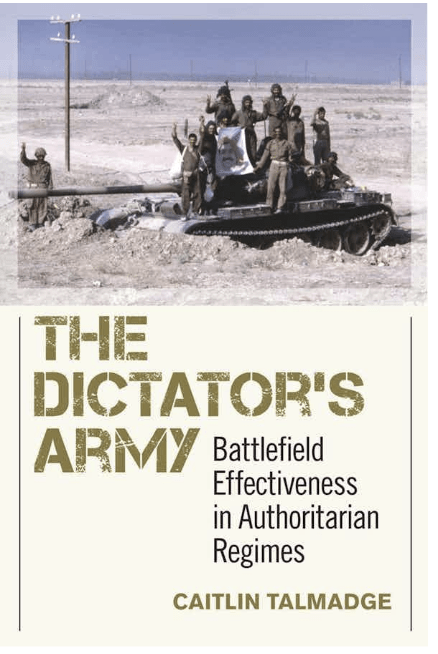
As Caitlin Talmadge points out in her 2015 book The Dictator’s Army, the factors that make militaries effective at maintaining internal regime stability typically reduce their effectiveness at fighting foreign adversaries. Militaries that are professional enough to fight a foe also pose a potential risk to their own unstable regime. Conversely, a military command structure of uncoordinated sycophants poses a threat to neither the regime nor foreign adversaries.
In Chalice of Poison, the transition from a loyalist military to a professional one will not be easy or clean. Players have a wide berth to experiment with different military reforms and command structures, but each experiment may increase the risk of internal political problems. Players are less limited by their total amount of power than by how risk-averse they want to be in expending this power. They will need to make trade-offs carefully. If military defeat or internal stability hits a breaking point, it will come suddenly, unexpectedly, and with force, and the game will end.
Future games in this series will likely focus on other historical conflicts where major dynamic changes occurred within the halls of state power and the military command structure, rather than with territorial exchanges on the battlefield. The system favors conflicts between weak or developing states with significant internal tensions, especially those where foreign adversaries are prone to meddle in their internal affairs. It best models conflicts that may seem like a slog when played out with traditional wargame mechanics, but are more engaging when the game focuses on the political struggle in addition to the territorial one.
The game system owes a lot to the trend of wargames in recent decades that focus on the political aspects of conflict, to include the Cold War competition of Twilight Struggle, the popular support focus of the COIN series, and the interplay between conflict and peace negotiations in the Great Statesmen series. This system builds upon that tradition to create a game that models internal regime tensions as they relate to war.
Additionally, the game system does not have a name yet, despite lots of ideation. So, if you have a good idea of what it might be called, please make a suggestion in the comments!
How does this game play?
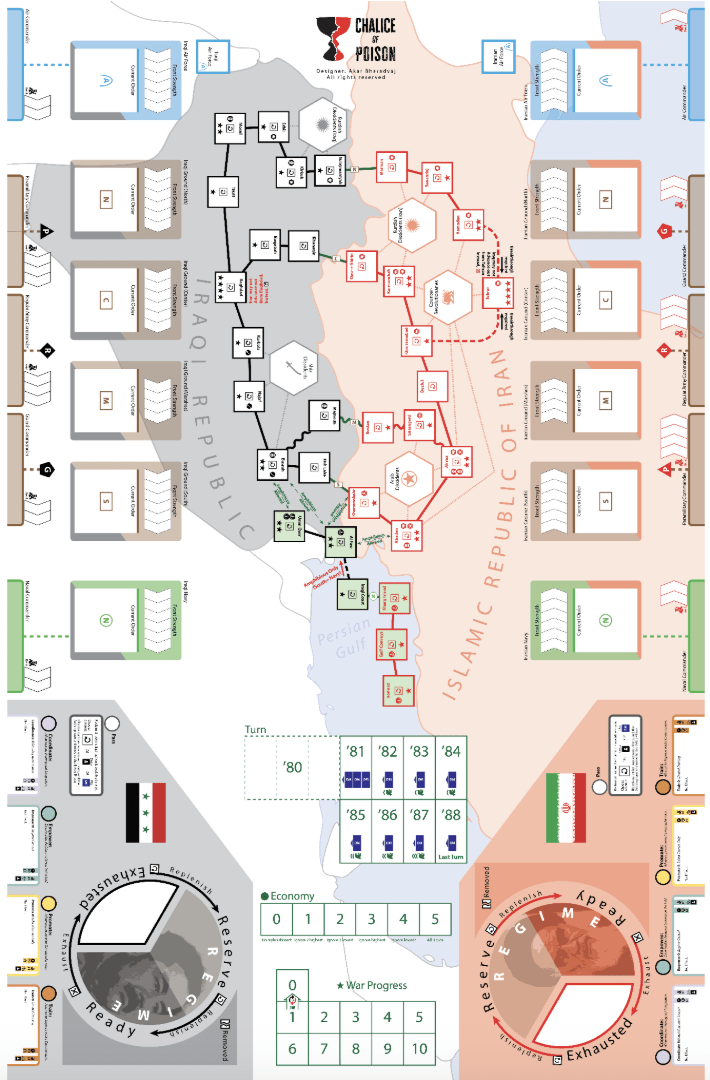
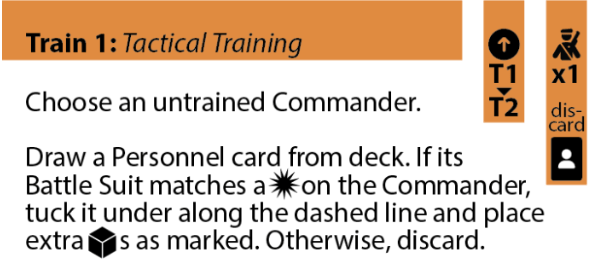
At Chalice of Poison’s core are political power cubes, which represent the players’ “currency” to make the systemic changes necessary to win the war. Reforming the military, promoting new commanders, training existing commanders, allowing commanders to coordinate with each other, and allowing commanders to make decisions all require exhausting or placing political power cubes. Each of these changes enhances a player’s flexibility in dealing with the large number of threats that will emerge in conflict.

However, players must hold back some political power in their Regime pool, or else risk negative consequences. The fewer the cubes left in the pool, the more unstable the regime is, and the higher the risk of threats from dissident groups and coup attempts. Players push their luck when making these changes; they have the freedom to expend lots of power each turn, but they will not get it all back quickly.

Each turn, players will set out orders across up to six different fronts on a simple battle map during the Planning Phase.

During the Action Phase, players will use their political power cubes to make changes to their militaries and attempt to improve their ability to carry out these orders.
After making these changes, players will resolve all battles in the Battle Phase, changing territorial control as required.

Finally, players will resolve internal security concerns during the Unrest Phase. If their dissident groups or commanders are too strong, they will suffer negative consequences.

Players win by capturing a certain amount of key territory from their adversary on the battle map. They lose if their regime collapses (runs out of political power cubes).
Thanks for reading this first InsideGMT article about Chalice of Poison and its game system! The next article will be about how I started designing Chalice of Poison, and why I chose this underexplored historical setting for a game.


Author: Akar Bharadvaj
