

At the proverbial 10,000 ft. view, Simple GBACW (or Simple Version) looks very similar to the GBACW Series Rules. It should of course, because they both use the same maps and counters for units and leaders. The Sequence of Play and the flow of the game are very similar as well; each division receives a number of Activation Markers (AMs) at the beginning of each turn, all AMs are placed in a randomizing cup and then drawn one at a time to determine which units and leaders can move and fight. Additionally, all leaders determine if they are in or out of command and orders are assigned (see below).
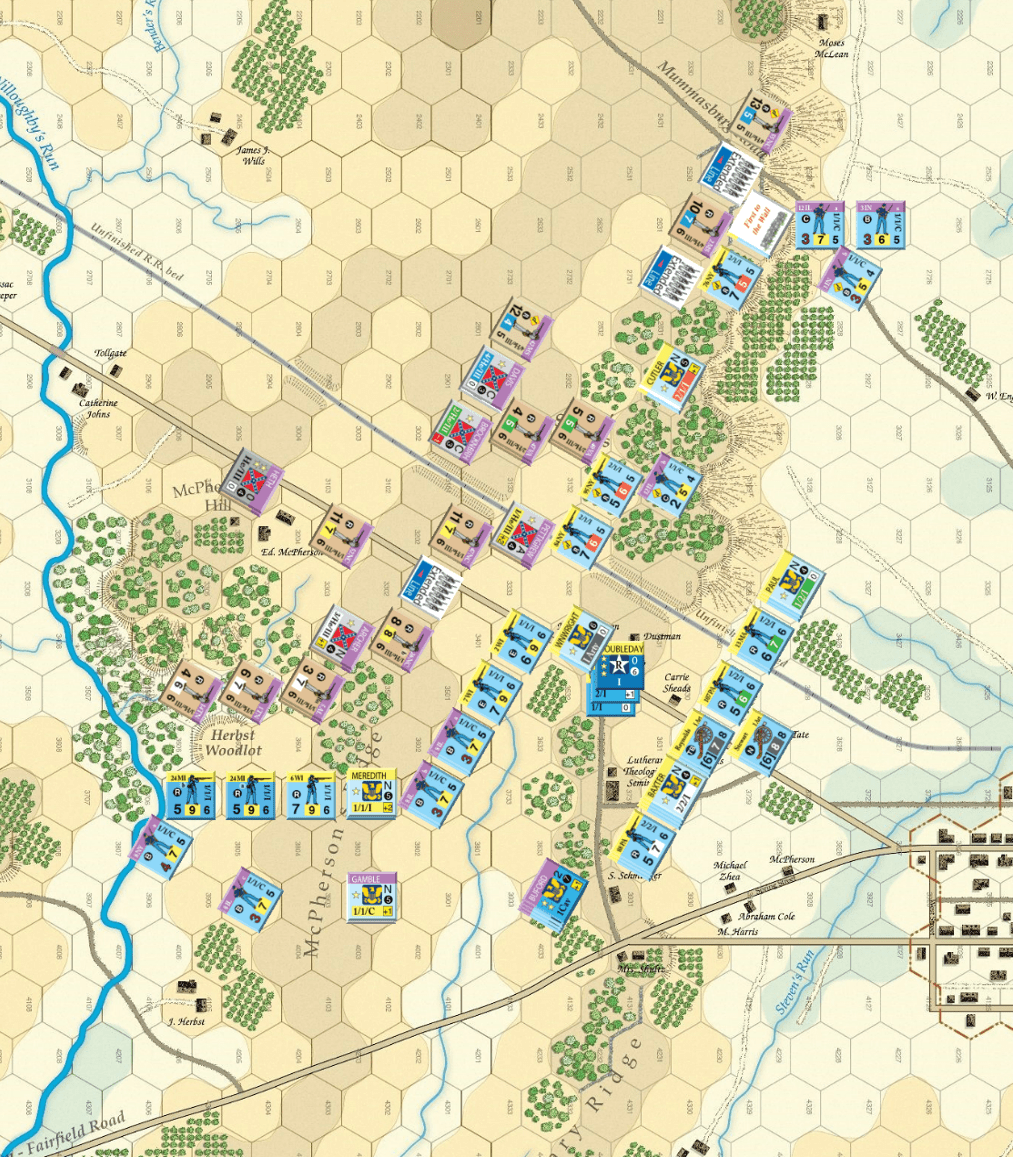
Zooming into a division’s activation, differences between the Simple Version and the Series Rules become manifest. The division as a whole completes the several phases together, unlike the sequential brigade activations used in the Series Rules. When a division activates in the Simple Version, all units in the division determine if they are in or out of command before any movement. Then each unit moves as desired. All disordering terrain effects and enemy reactions take place after the unit has completed its movement. This contributes to faster play as the phasing unit is able to complete its movement without interruption. Non-phasing units can react to certain phasing units’ movement, including changing facing or moving away. Instead of moving, phasing units that are Disordered (see below) may attempt to return to Good Order.
The stacking limits are unchanged from the Series Rules; however, they are only in effect at the end of movement (and advances and retreats). Stacking order has no effect on play. Units must be faced towards the vertex of their hex, but an optional rule Refused Flank mitigates the effects of the rigid hexgrid.
After all movement is conducted, non-phasing artillery may use Approach Fire to shoot at enemy infantry or cavalry that moved adjacent to them. Then all phasing combat is declared and resolved. Simple GBACW has one mechanic that covers both ranged fire and close range shock. Firing is optional, unless the phasing unit moved adjacent to an enemy unit. Non-phasing units return fire, with both fires conducted simultaneously. Die Roll Modifiers (DRMs) for fire combat include the number of men firing, terrain effects, the weapon of the firing unit, whether the firing units are disordered, and whether the firing units are in the target’s flank or rear.
Fire results consist of Cohesion Checks, Cohesion Hits and Strength Point (SP) Losses. Cohesion Checks are a simple die roll compared to each unit’s Cohesion Rating in the target hex to determine if they suffer a Cohesion Hit and are used for various other game functions. When a Good Ordered unit suffers a Cohesion Hit, it is flipped to its Disordered Side. When a Disordered unit suffers a Cohesion Hit, 1 SP Loss is accrued and, if the Cohesion Hit is the result of fire combat, the unit also retreats. Uniquely, SP Losses are tracked by brigade for infantry and cavalry although each battery of artillery tracks its SP Losses individually. Simple GBACW makes it easy to assess the situation at a glance as the unit counters are either Good Ordered or Disordered, with no SP markers stacked underneath or information markers on top.
After combat for the division is resolved, both the phasing and the non-phasing players conduct attrition. If an infantry or cavalry brigade has 7 or more SP Losses, the player must remove units of that brigade from the map, subtracting the units’ strength from its brigade’s SP Loss total, until the brigade has fewer than 7 SP Losses. When at least half of the units of a brigade are routed, the brigade becomes Combat Ineffective with appropriate penalties to its units. Divisions become Combat Ineffective as when at least half of its brigades becomes Combat Ineffective.
The activation sequence is repeated for every AM pulled from the cup. When no AMs remain, players perform a few housekeeping procedures before moving on to the next turn.
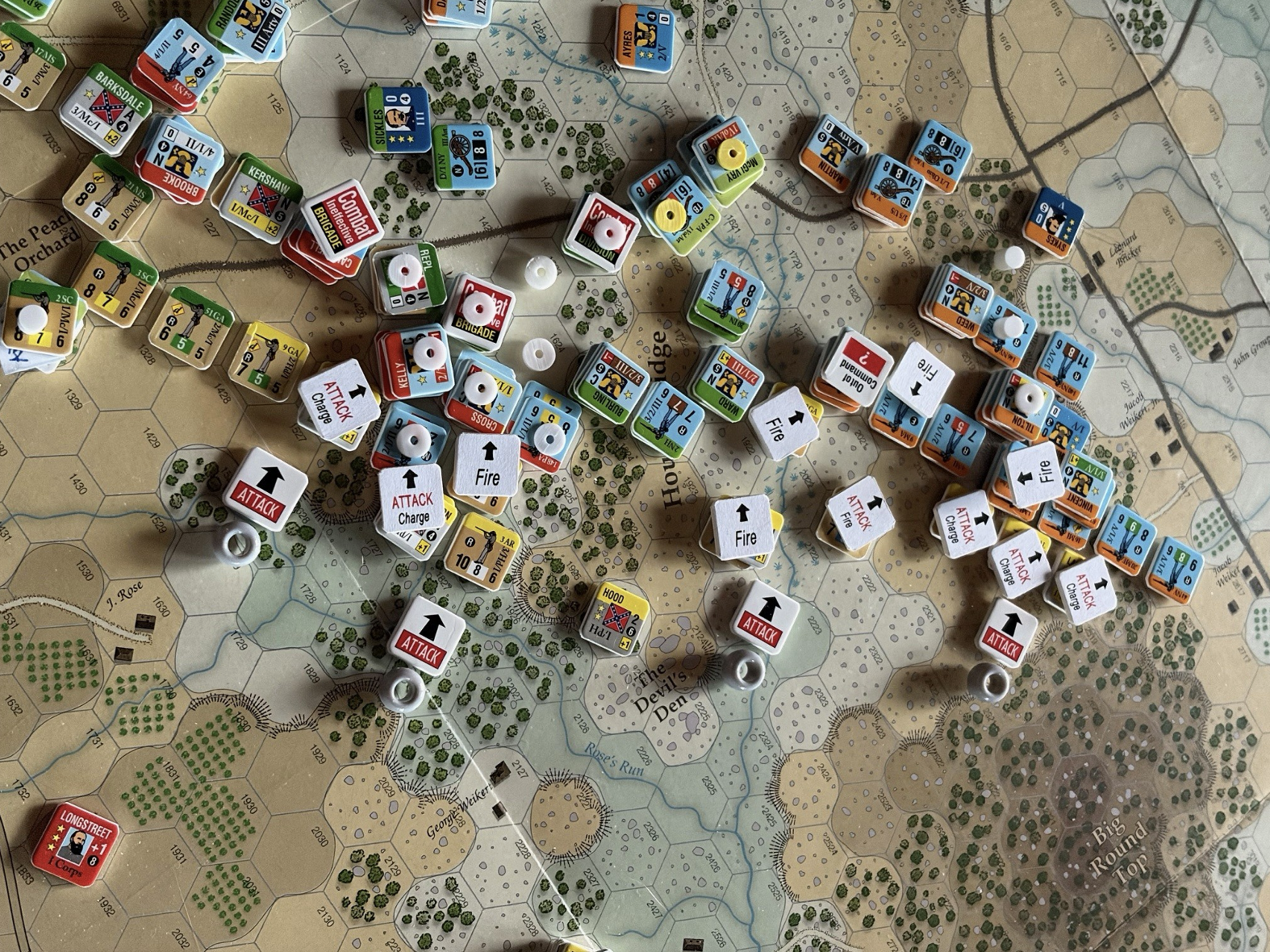
Persistent orders, assigned at the brigade level, are a core feature of the GBACW Series Rules. Simple GBACW allows brigades to freely switch between normal posture and Attack Posture (which replaces the Series Rules’ Attack Orders). Infantry and cavalry units of a brigade in Attack Posture may both move and fire in the same activation and, more importantly, move adjacent to enemy units, neither of which other units may do. But such units have their movement allowance halved, representing difficulty of moving the troops while in linear formation and accounting for time spent in combat. Brigades may be assigned either March or Reserve Orders, which, like the in the Series Rules, persist for the entire turn but allow units to move much further (for March Orders) or to recover routed units (for Reserve Orders). However, brigades under orders are vulnerable if attacked and so should be wary of any close enemy units.
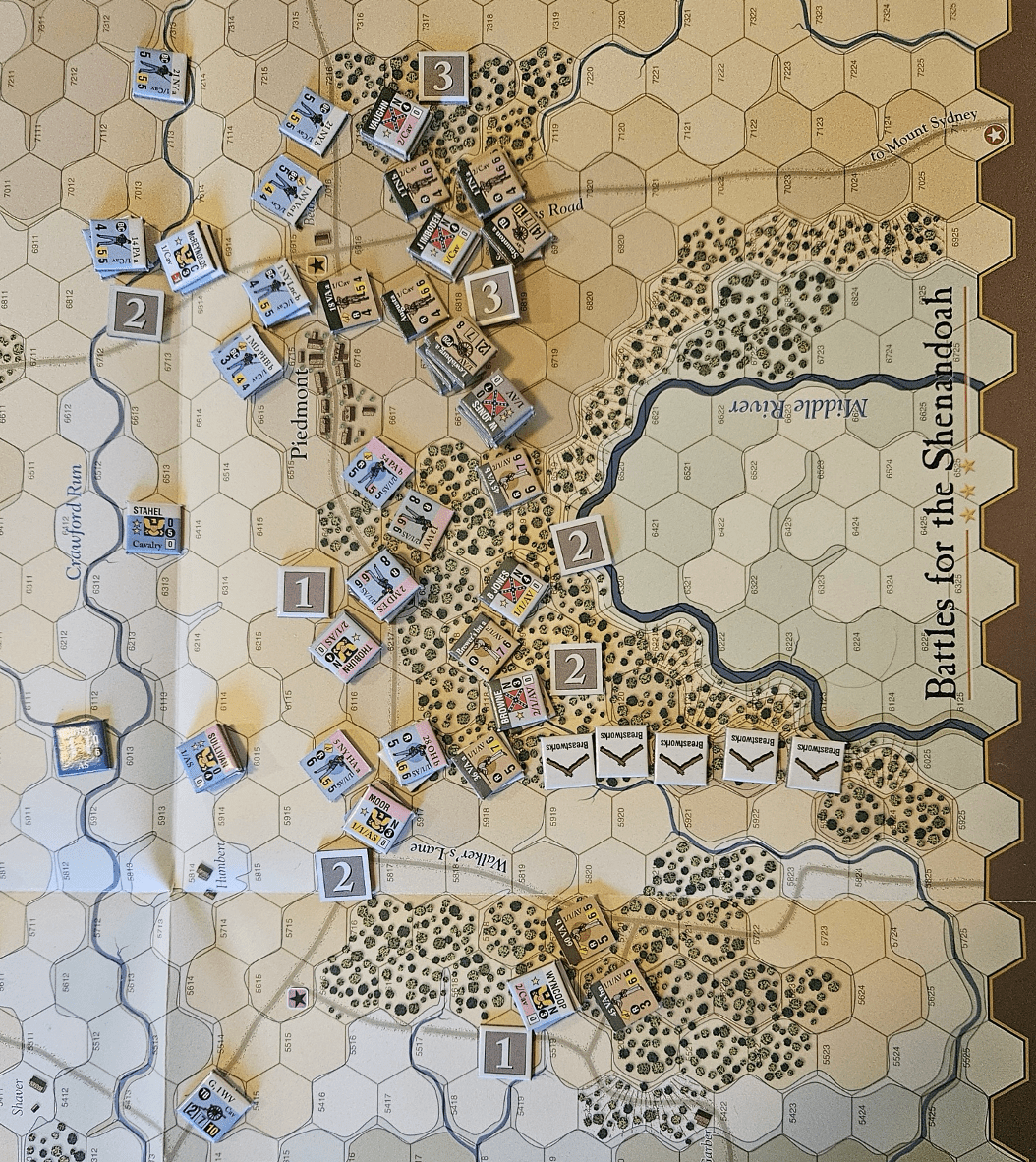
This article contains merely an outline of how SGBACW works; the historical design rationale will be included as part of the Designer’s Notes included in Three Days of Gettysburg – Deluxe Edition. Other features of Civil War combat not mentioned include: breastworks construction, night fighting, mounting and dismounting cavalry, abandoned artillery, and artillery bombardment. A section of optional rules add even greater depth, including Green Units and Extended Lines, but are not essential to enjoy SGBACW.
Simple GBACW contains the distilled essence of combat in the American Civil War, offering players a smooth playing system that delivers a good feel of combat in that era. By focusing on the brigade as the primary unit of maneuver and attrition, Simple GBACW offers a faster playtime with a shorter rulebook without sacrificing historical accuracy or fun. Simple GBACW is certainly not a simplistic game but it allows players to fight the battles and not the rules.
The next article will show how Simple GBACW plays through a short after action report.

Author: Nathan Mueller

SGBACW rules will be included in 3DoG Deluxe???
Is GBACW related to the old SPI GBACW?