

The Xiongnu were the bane of ancient Chinese civilization for centuries. These fearsome nomadic horse lords of the steppes, depicted as Desert areas on ACEA’s map, often had a chokehold on the east-west trade routes which later became known as the Silk Road. With their powerful cavalry and enriched by tolls (and outright robbery), the Xiongnu swept down from the steppes and deserts to literally conquer vast swathes of northern China in the 3rd and 4th centuries before the Christian era.
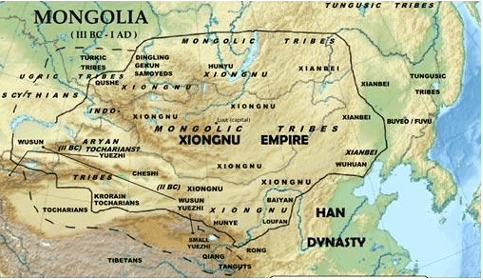
The dominant power in the north for nearly 500 years, the Xiongnu were finally turned back by the Han, who, when the Xiongnu are ACEA portrayed by the black disk Barbarian Invasion Event Card #107, Steppeland Raiders, made use of what is represented in the game by the “Cultural Absorption” rule to divide and eventually subjugate and incorporate these nomadic peoples into the Han civilization. As to the direct Xiongu player Civilization, the Han Empire’s use of vast military power, with increasingly effective border fortifications, brought them to heel.

The Xiongnu can be a wargamer’s dream civilization. Although their Nomad Culture trait prevents them from building Terraces, Workshops, the Great Wall or the Grand Canal, or gaining victory points through building cities or advancing along the Cultural Development Display’s Tracks, they are rewarded for simply occupying land areas and gaining 1VP for every three areas occupied. Of course, they can gain these points by doing so peacefully, sharing occupancy with other civilizations (provided no one places a second disk into an area, which triggers Competition), they should also be looking for targets of opportunity – notably other civilizations’ Cities to attack, destroy and loot.
Such wonderfully barbarian behavior is encouraged by this civilization’s Fierce Mounted Warriors trait, which allows them to add a white disk in up to three Competitions in non-Mountain, non-Jungle areas. By destroying enemy cities and their accoutrements: Terrace/Improved Irrigation System and Workshop counters, the Xiongnu can gain captives, taels (the money in the game) and victory points. Furthermore, by sacking enemy Cities, they could reduce their foes’ progress (or the ability to gain the benefits of such progress) on the Cultural Development Display.
The Xiongnu also have the opportunity to make money by taking advantage of their Silk Road Toll power, which gains a tael for every Silk Road desert area they control. (There are four such areas: Takla Makhan, Yungchon, Handan, and/or Zhao. That could make for a windfall of money each turn with only more possible from other sources! See Figure #4’s map below.)
They begin the game automatically awarded the Philosophy of Traditionalism: which generates two disks each Growth Phase. Furthermore, the Xiongnu are unique, through their “Yurt” attribute, to generate a disk for each of their Desert Area two disk Settlements (again, think of these as sprawling steppe encampments).
The Xiongnu are ideal not only for those players who want to make Ancient Civilizations of East Asia as if it were a war game, but also for new players who’ve gained some familiarity with the rules – as they are exempt from the burden of building Cities or investing in Cultural Development and are free to just go about doing what barbarian warriors do best – kill, loot and destroy their rivals!
To learn more of this fascinating nomadic East Asian Civilization, please reference: Xiongnu – Wikipedia. There are also a number of YouTube videos concerning them, This is one of the better ones: The LOST EMPIRE That Terrified China — The Rise and Fall of the Xiongnu. For more items, see here.
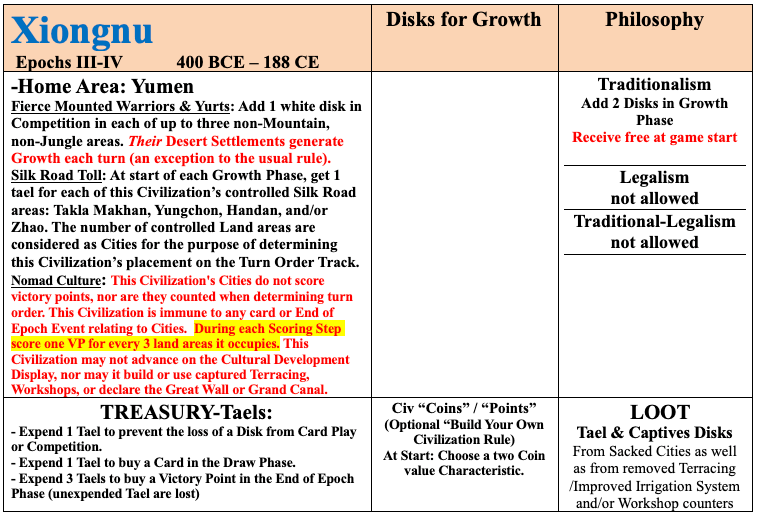
What’s new with ACEA is the “Build Your Own Civilization” Section, which allows players to modify an Urbanized Civilization through an optional rule and the ability to choose a “Philosophy”, even the nomadic Xiongnu are allowed to utilize this option! However, they may not select additional Civilization Characteristics involving the Cultural Development Tracks Display or Cities… but there are PLENTY of others to choose from! The Xiongnu automatically possess Traditionalism for the entire course of a game and may not adopt either of the game’s other two Philosophies.
Furthermore, as the preceding article text describes, the Xiongu can be rewarded through occupying as many Land areas possible and potentially gaining copious advantage towards game victory each turn via captives, tael, and VP through sacking enemy Cities.
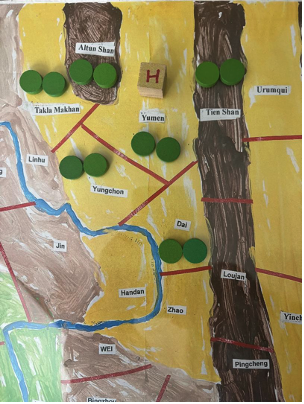
The Xiongnu’s unique “Yurt” Civilization Attribute allows them to have Growth from a Desert Settlement as well as a tael for each “Silk Road” area under their control. Therefore, ignoring the possibility of Commerce with another Civilization, for the above Figure 4, the Xiongnu would receives two tael for the controlled Silk Road areas of Takla Makan and Yungchon: placed on their Display’s Treasury Section and seven disks, one for the two Mountain area Settlements with four more disks, one for each Desert (think Steppe) Settlement as well as two disks for their “Traditionalism” Philosophy. These are placed on their Civilization Display’s Disks for Growth Section for the upcoming Deployment Step. The preceding Growth Phase calculations should be generally familiar to ACIS and ACME players.
The Xiongnu Civilization is a selection for any Standard ACEA Game with 5-6 players.
Next up in this “Meet the Civs” Series is ACEA’s second nomadic Civilization, the Peoples from the Sea, whose Homeland is in what is now Indonesia and whose oceanic-sourced power can extend to any coastal area of the game map and possibly beyond!
Previous Ancient Civilizations of East Asia “Meet the Civilizations” Articles

