

By Mark McLaughlin & Fred Schachter
The Peoples from the Sea represent the oft forgotten and overlooked amalgam of nomadic tribes that have roamed the seas around Southeast Asia since before the dawn of kingdoms and nation states. Since more than one tribe is involved, ACEA identifies them as “Peoples from the Sea” rather than the more common parlance: “People of the Seas”.
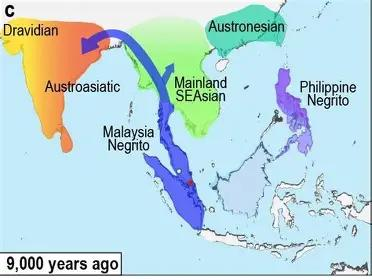
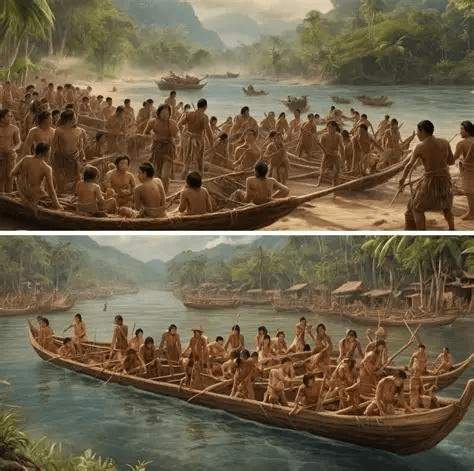
Their descendants, some of whom are also referred to as “Sea Gypsies” or “Sea Nomads”, continue to practice that itinerant lifestyle. These are no mere migrants. Prior to European colonization, they were a powerful merchant and naval culture that dominated the seas around the kingdoms and sultanates of Borneo, Sulawesi, and other areas from the South China Sea to the Sulu Archipelago. They also converted to Islam prior to the arrival of Europeans although to this day, some still practice the animism of their ancestors.
To represent their nomadic culture, the Peoples from the Sea civilization does not gain any victory points for building and having cities, nor may they advance on the Cultural Development Display or construct Terracing/Improved Irrigation Systems, Workshops or either the Great Wall or the Grand Canal. Like the Xiongnu of this series prior installment, they’re NOT an urbanized civilization akin to those of the China Heartland, Korea, Japan, and Southeast Asia.
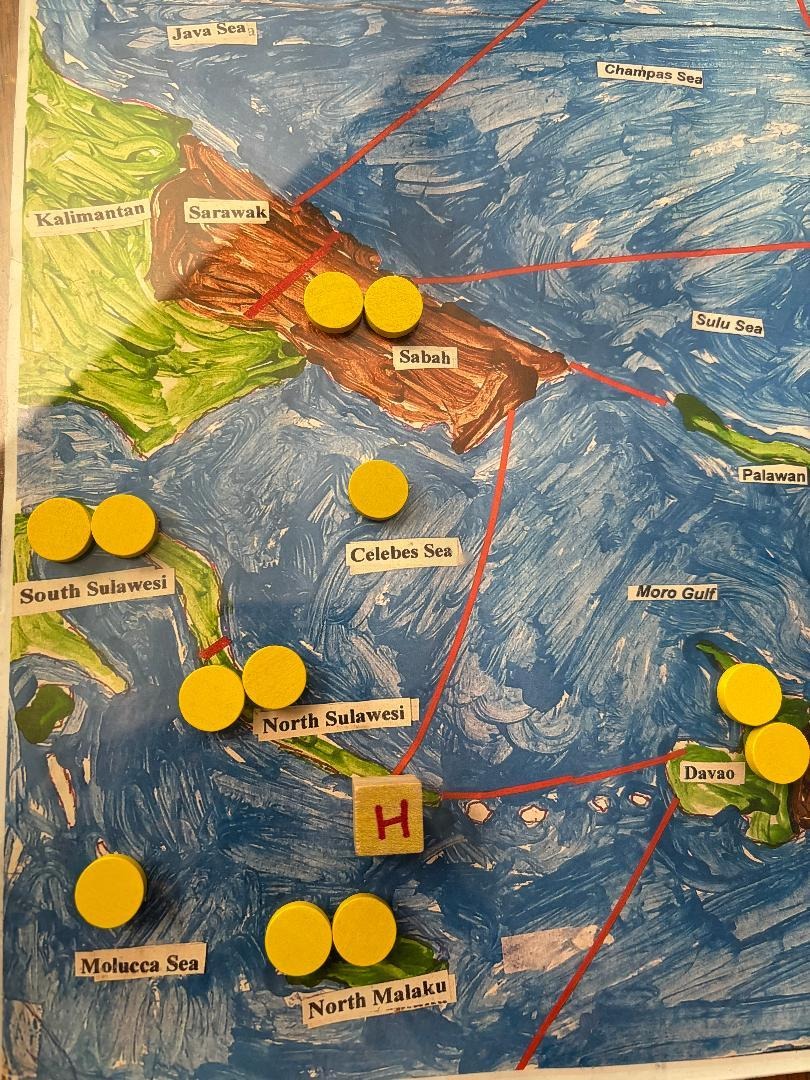
Instead, this civilization has a powerful Nomad Culture trait. It begins in the far corner of the board (always a safe space to start) and focuses almost exclusively on spreading out across the sea to occupy land areas. They need not control those areas but merely be present to gain victory points, which they do for every three land areas they occupy. Thus, they may gain victory points by peacefully coexisting with other civilizations – and even Barbarians – at least until they or someone else places a second disk in that area thus initiating Competition.
To aid them in this quest, and to represent the increasing tide of nomads, the Peoples from the Sea gain a number of disks and/or tael, yes, ACEA’s money, for they were oceanic traders of renown, equal to the turn number (1, 2, 3 or 4) at the beginning of their Growth Phase. This is in addition to the two disks they can receive each turn as practitioners of the game’s “Traditionalism” Philosophy. This is a free at game start, irrevocable Philosophy for them. They may not convert to “Legalism” or “Traditional-Legalism”, ACEA’s other two Philosophies, as they are steadfast in their beliefs.
To learn more about the Peoples from the Sea, far more than this article can convey, see: Sama-Bajau – Wikipedia. There are also a number of YouTube videos for further exploration if a reader desires.
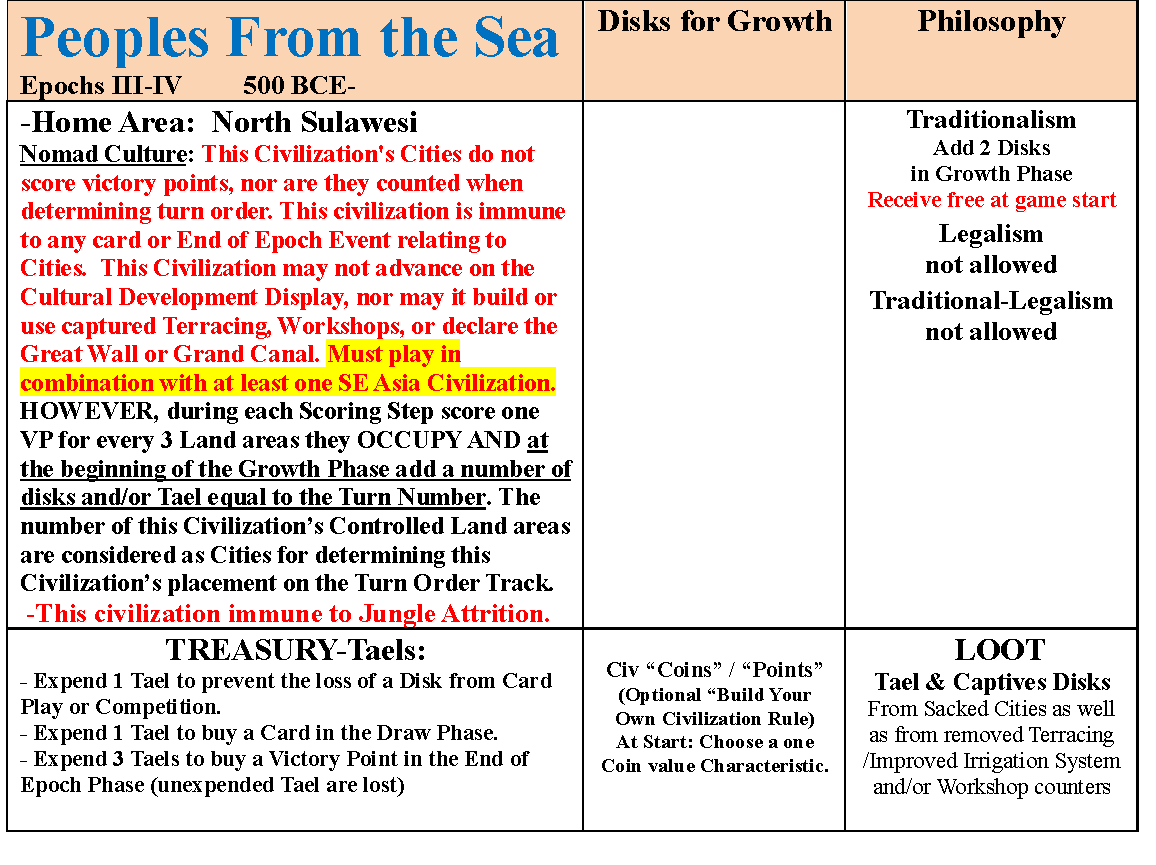
What’s new with ACEA is the “Build Your Own Civilization” Section, which allows players to modify an Urbanized Civilization through an optional rule. Even the nomadic Peoples from the Sea are allowed to utilize this option! However, they may not select additional Civilization Characteristics involving the Cultural Development Tracks Display or Cities… but there are PLENTY of others to choose from! The Peoples from the Sea automatically possess Traditionalism for the entire course of a game and may not adopt either of the game’s other two Philosophies.
It should be noted that in a multi-player, or Civilization, Ancient Civilizations of East Asia game, if the Peoples from the Sea Civilization is to participate, at least one Southeast Asian Civilization must also be in the game! That could be one of four: the Dong Son, Southeast Asian City States, Malay, or the Van Lang [Vietnamese].
Playtesting revealed potential local opposition is necessary for game balance purposes, so at least one of the above-cited four Civilizations must be in any ACEA game involving the Peoples from the Sea. For as the preceding article section describes, the Peoples from the Sea can be rewarded through occupying as many Land areas possible and potentially gaining copious advantage towards game victory each turn via captives, tael, and VP through sacking enemy Cities. Furthermore, by sacking enemy Cities, they could reduce their foes’ progress (or the ability to gain the benefits of such progress) on the Cultural Development Display.
They were known as ancient raiders and pirates (a role which notoriously persists into our modern era), and a Peoples from the Sea player is offered the tantalizing delight of spreading across the seas to threaten the vast swathes of sea and coastal areas comprising ACEA’s game map.
The Peoples from the Sea’s immunity to ACEA’s “Jungle Attrition” rule gives them a defensive advantage against the main China-area based Urban Civilizations, as well as those north of the China Heartland, who may seek to attack or encroach upon them. This rule compels any non-immune Civilization to remove a disk from a Jungle area, even if it is the only disk occupying it, at the very beginning of each turn’s Reckoning Phase. This disk removal may not be cancelled in any manner whatsoever (e.g. through a Civilization expending a disk from its Treasury). Of course, if the opponent is one of the game’s other immune to Jungle Attrition Civilizations… well, that makes for a more balanced and typical contest between players.
The Peoples from the Sea Civilization is a selection for a Standard ACEA Game with 6 players.
Next up in this “Meet the Civs” Series is ACEA’s other Civilization which could be Standard Game selected in lieu of the Peoples from the Sea, Japan, an urbanized Civilization, like the others described in this series, whose oceanic-sourced power can extend to any coastal area of the game map and possibly beyond!
Previous Ancient Civilizations of East Asia “Meet the Civilizations” Articles

