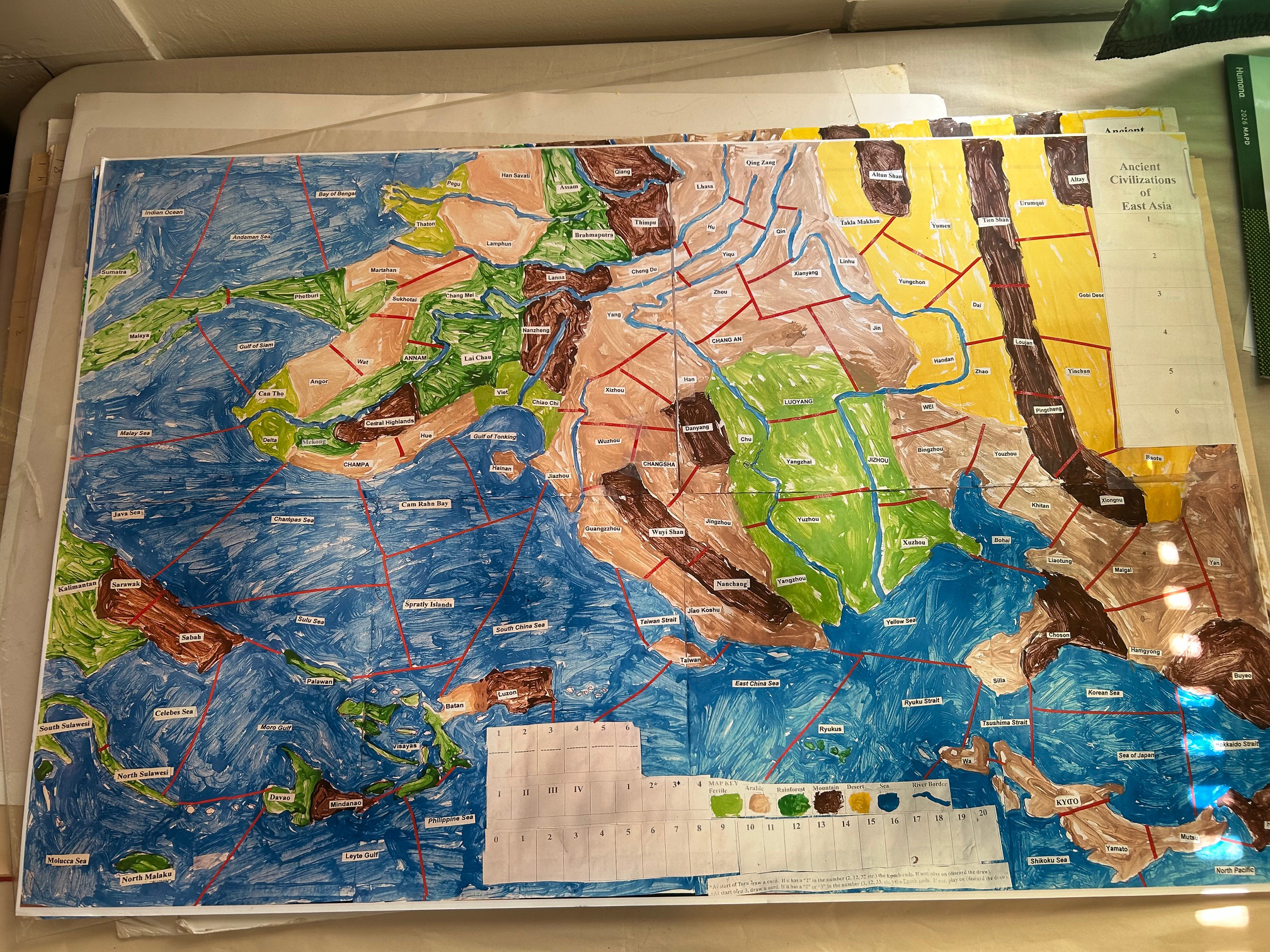

The Jin (also often known as the Wu in deference to the Jin’s founder, Emperor Wu) played a vital role in many of the wars of ancient China’s unification – and in the rebellions that undermined such efforts to bring China under the rule of a single dynasty.
They were an inventive, artistic, and highly productive civilization. The Jin ACEA player can quickly amass riches through use of their Celadon Porcelain bonus, which when the requisite Cultural Development Economic-Social Track’s Level 3 or 4 is achieved, allows them to acquire a free Workshop each turn for the long term, or, prior to that Cultural Development, just gain two tael immediately (the money of the game).
If the Wu Rebellion variant is chosen, however, the Jin can forgo the Workshop bonus and instead gain two white disks (representing mercenaries, allies, or other military advantage) for use in Competition, thus making it a martial power with which to be reckoned.

To learn more of this fascinating, sophisticated, yet doomed by factionalism, ancient civilization of China, see: Jin dynasty (266–420) – Wikipedia. There are also YouTube videos regarding them which readers may find of interest.

What’s new with ACEA is the “Build Your Own Civilization” Section, which allows players to modify the Jin [Wu] Civilization through an optional rule and the “Philosophy” Section. When the Jin [Wu] player selects a Philosophy, either Traditionalism, Legalism, or Traditional Legalism, a white disk is placed over the choice to memorialize it.
The Jin [Wu] are unusual in that they have three possible Homeland areas. Luoyang, the westernmost Fertile area of the China Heartland adjacent to Chang An (See: ACEA_Playtest_Map.jpg (2016×1512) ) or the Arable areas of Wuzhou or Changsha pictured below.

The Jin [Wu] are well positioned to expand in every direction of the compass… north into the China Heartland’s Fertile areas, south towards Southeast Asia, east via Sea to the limits of the abbreviated map if a Standard Game is being played (or further yet towards Taiwan, the Philippines and what is today Indonesia for a full map contest), or west to the board’s edge: temptations, temptations! What a game’s other Civilizations will do about unfettered Jin [Wu]expansion, or simply the threat of it, is another matter… one requiring patient, convincing, and adroit negotiations.
The Jin [Wu] Civilization is a selection for any Standard ACEA Game with 3-6 players.
Next up in this “Meet the Civs” Series is the Southeast Asian, Jungle-based, Dong Son Civilization.
Previous Ancient Civilizations of East Asia InsideGMT Articles