

By Mark McLaughlin & Fred Schachter
The Han Dynasty ruled during what is often referred to as the “Golden Age” of Ancient China. Building upon a base set by the relatively short-lived Qin*, the Han created a Confucian bureaucratic edifice based on merit which gave China its first truly effective centralized government. Han emperors are also credited with allowing and encouraging the introduction of Buddhism into China. The dynasty’s 400-year reign (202 BC – 220 AD) was marked by brilliant scientific and cultural advancement in many disciplines, as well as a flourishing of the arts.

This is reflected by the Han Civilization’s ability to draw an additional card free of cost each turn, while still abiding by the six cards in hand limit… but it’s nice to have an extra card to choose from. Also important is their “Invention of Paper” advantage which allows the Han to advance on each Track on the Culture Development Tracks Display at a one Resource discount for each advance (while paying at least one Resource each). Players have a choice of 2 starting areas, as scholars break the dynasty’s reign into two eras, an earlier one based in the west and a later one based in the east.
The Han’s centralized rule was, at times, dominated by court eunuchs. This was increasingly so during the first century A.D. and is reflected in the ACEA game by Negate Card #19, Eunuch Coup (Eunuchs Plot to Gain Control), which reads: “Negate any Great Person Card AND the victim of the Negation must lose a VP if the victim’s Civilization has any VP.” Nasty are those eunuchs are they not?

For those desiring to learn more of the Han, see: Han dynasty – Wikipedia. There are also YouTube videos available regarding them. Here’s one video InsideGMT readers may find of particular interest: The Rise & Fall of China’s Han Dynasty Empire…and it’s Rise & Fall Again
(*the Qin are among the 19 civilizations available for players to choose from when playing Ancient Civilizations of East Asia and will be discussed in upcoming editions of “Meet the…” series).
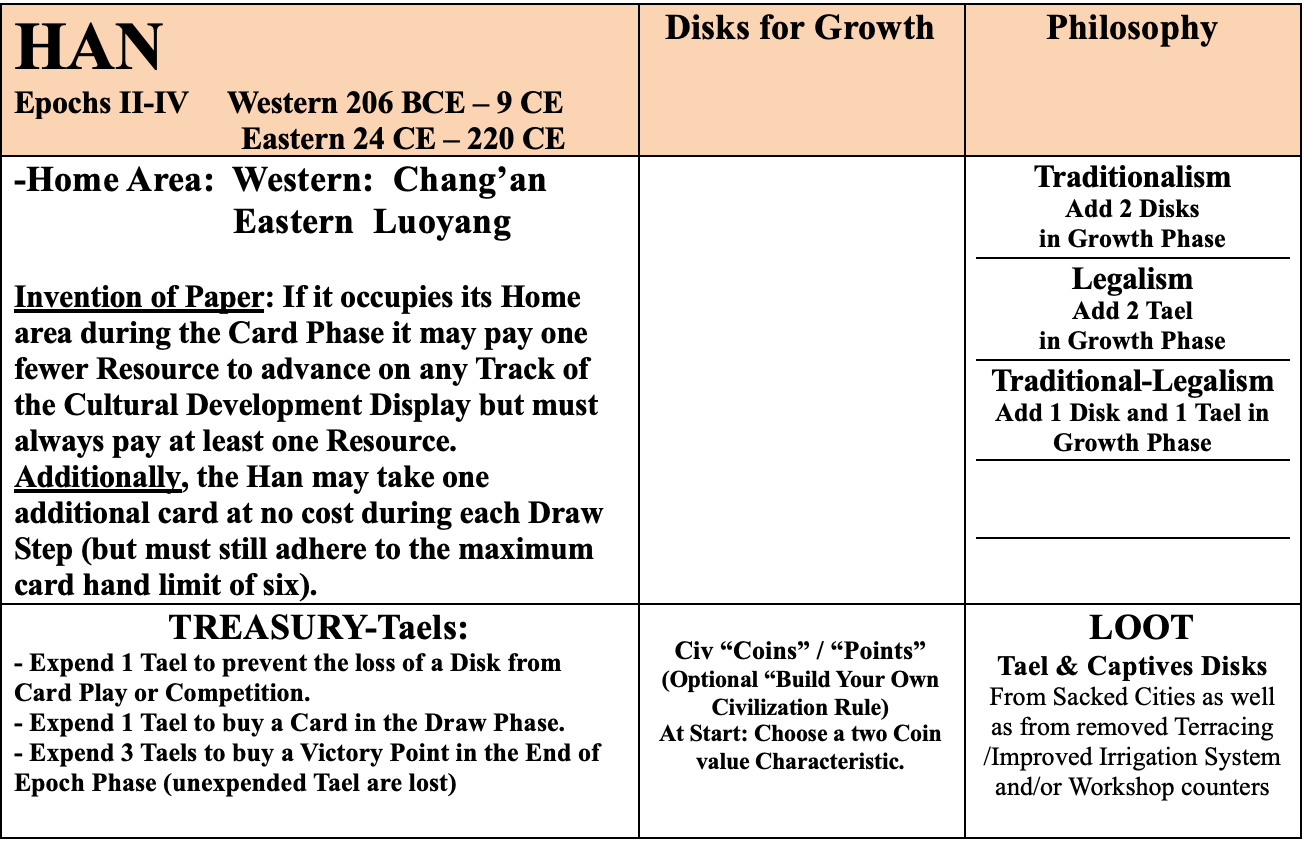
Figure 1: ACEA’s Civilization Display for the Han: This format should be familiar to those who’ve played either of the other two games of GMT’s “Ancient Civs.” Series: Ancient Civilizations of the Inner Sea and/or Ancient Civilizations of the Middle East. For more information, see these games’ GMT Sites for their Rulebooks & other game material.
What’s new with ACEA is the “Build Your Own Civilization” Section, which allows players to modify an Urbanized Civilization such as the Han through an optional rule and the ability to choose a “Philosophy”. This becomes even more significant when combined with their “Invention of Paper” Civilization attribute.
ACEA’s Cultural Development Tracks Display is similar to that introduced for ACME and ACIS as an optional rule via an InsideGMT article: Optional Cultural Development Tracks for Ancient Civilizations of the Inner Sea (ACIS) and Ancient Civilizations of the Middle East (ACME) – InsideGMT. Imagine acquiring an additional Military Civilization attribute via the “Build Your Own” option in combination with the Han’s discount for acquiring each Military-Political Track advance. This one-two punch can make the Han most formidable indeed! Sorry for the “teaser”, but there’ll be a future InsideGMT article concerning ACEA’s Optional “Build Your Own Civilization” Rule. Readers’ patience is appreciated.
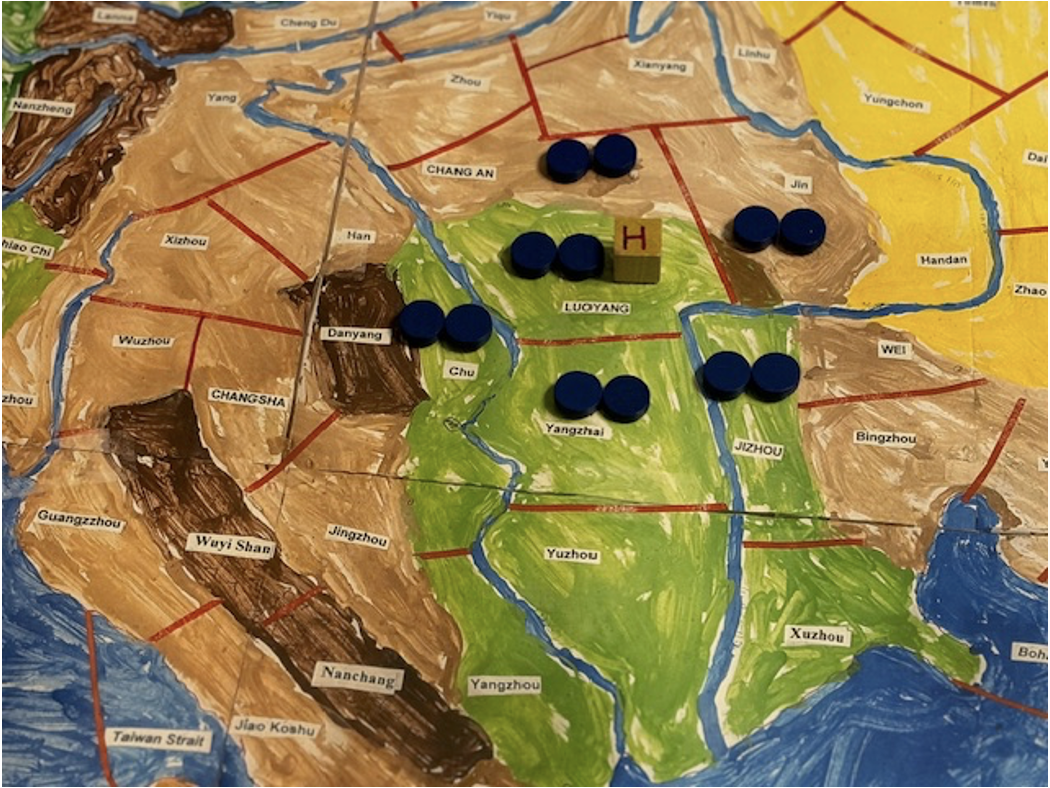
Figure 2: The Han’s initial placement of disks on ACEA’s playtest map: The “H” small wooden block indicates the Standard Game’s Han Homeland, for the Eastern Han, the Fertile area of Luoyang and its five surrounding Land areas (the produced game’s component will be similar to ACME’s Homeland Blocks).
This seems a good opportunity to explain a major factor in why the Han managed to expand and dominate China as much as they historically did: geography! Here’s a YouTube video which does a fine job explaining how Ancient Chinese history was influenced by where Dynasties originated: Intro to Historical Chinese Geography. The authors of this InsideGMT piece were particularly impressed when, at Time Mark 2:48, the videographer states: “Ancient China is not a place you want to be during chaotic times”. GMT’s Ancient Civilizations of East Asia is a game certainly validating THAT observation!
Next up in this “Meet the Civs” Series, we turn north for the long-lasting, yet oft beleaguered and smitten, Civilization of Korea!
Previous Ancient Civilizations of East Asia “Meet the Civilizations” Articles

