
According to the mythic account recounted by the Samguk yusa, written in 1281, the Gojosen Kingdom was founded in northern Korea and southern Manchuria in 2333BC. The Jin State was formed in southern Korea by the 3rd century BC. In the late 2nd century BC, Gojoseon, after a protracted war, fell to the mighty Han Dynasty of China, which led to succeeding warring states during the Proto-Three Kingdoms of Korea period.

Throughout these centuries, a Korean culture developed which, while heavily influenced by China, did possess many unique attributes of its own.

From the 1st century BC, the three states grew to control the peninsula and Manchuria. This became known as the Three Kingdoms of Korea (57 BC–668 AD), until the peninsula was united by Silla in 676. In 698, Dae Jo-young established Balhae in the old territories of Goguryeo, which led to the Northern and Southern States period (698–926) with Balhae and Silla coexisting… eerily like the North and South Korea of today.
The preceding was extracted from Widepedia. For more see: Ancient Korea – Search
However, in terms of the game of Ancient Civilizations of East Asia, Ancient Civilizations of East Asia, the player controls all Korea and has the opportunity to develop it militarily, politically, and culturally.

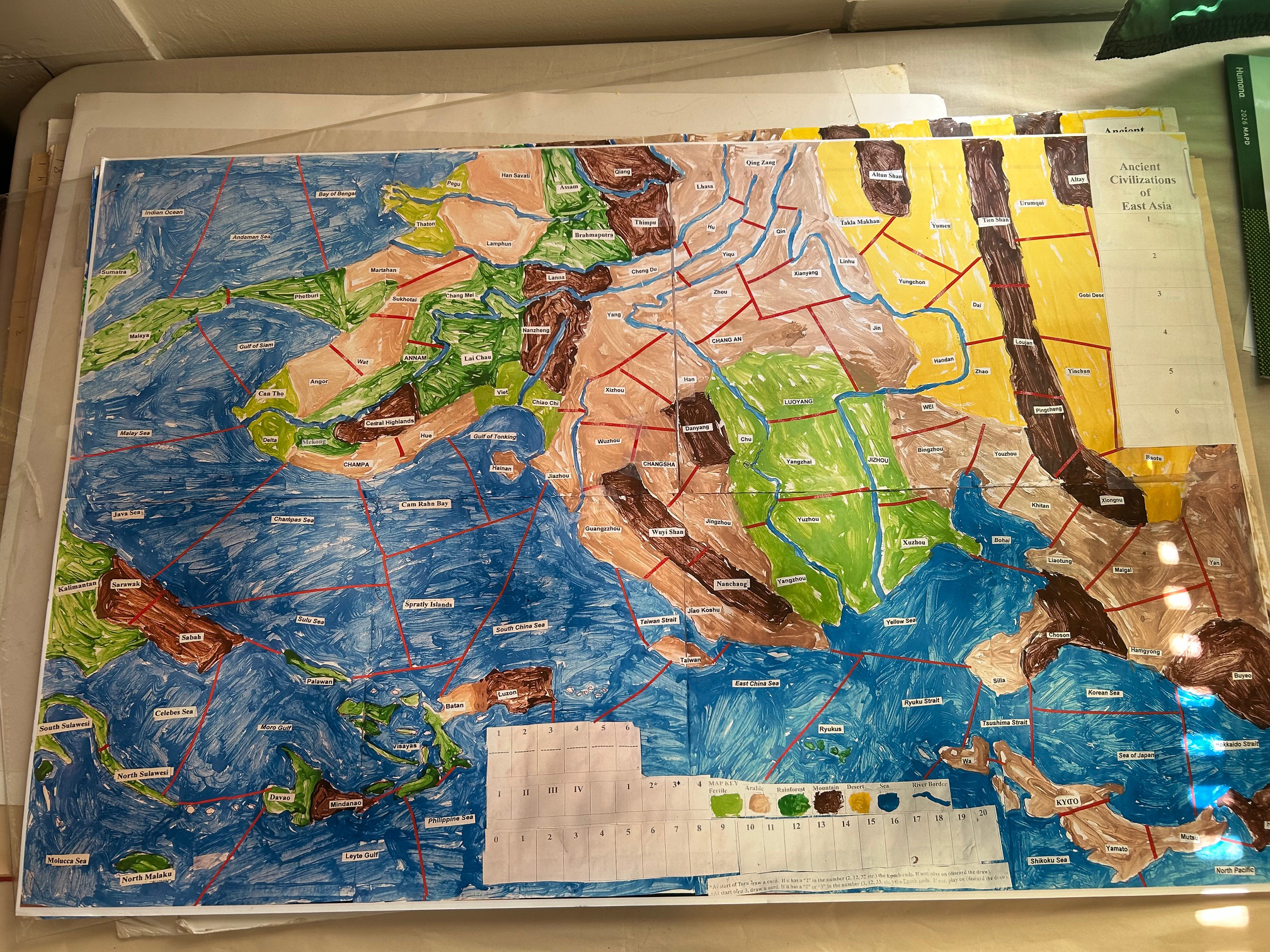
Korea, like its neighbor, Japan, offers a player a strong defensive base from which to “turtle” while seeking victory through advancement on the Cultural Array. Situated comfortably in a corner of the map (made especially more comfortable if the “No Japan” map option is chosen) Korea can invoke its “Invaders Face Horrible Weather” power to remove enemy disks from one of two areas, Silla or Choson, which can be chosen as a Homeland.
In addition to this defensive power, Korea can gain a freetael (the money in the game) simply by controlling both of those two areas. Korea is also useful as a base from which to effect a sea crossing to reach the mainland or beyond. An aggressive player can then choose to expand along the coast and/or overland deep into the Fertile areas of the Chinese heartland (or even Japan, if it is in a game). Opportunities, eh?

However, woe to Korea if both the Shang with their Homeland on the coast of the Yellow Sea in Xuzhou AND Japan, with its Homeland in Kyoto are two of the Civilizations in an ACEA game. To survive and prosper, the Korean player would then have to possess the glib tongue of a Metternich and the conniving of a Machiavelli. To better appreciate the dire situation Korea would find itself, see the entire Ancient Civilizations of East Asia game map: ACEA_Playtest_Map.jpg (2016×1512)
It’s rare for ACEA’s three designers to meet personally to play a game yet below is a photo of one such occasion with Mark McLaughlin playing Korea!

Mark took advantage of Korea’s protected “corner of the map turtled” position to expand into the fertile light green areas of the China heartland. This was not without resistance from Fred’s Zhou from the west and Rich’s Xiongnu from the north… but carve out a mainland empire was something Mark’s blue disk Korea managed to accomplish with panache and Mark’s years of gaming negotiating skills… a combination of offered benevolence and ill-concealed threat! What fun!
Next up in this “Meet the Civs” Series, we turn south, far to the south, for the Southeast Asian Malay Civilization!
Previous Ancient Civilizations of East Asia “Meet the Civilizations” Articles