
By Mark McLaughlin & Fred Schachter
Japan first made its mark on history in the Jomon period of the Mesolithic age – about 10,000 BC (six Millennia before the first era portrayed by GMT’s Ancient Civilizations of East Asia game). The incipient and then initial Jomon Periods were followed by four more of that name, with the Early, Middle, Late and Final Jomon periods corresponding almost exactly with the four Epochs of the game. Each period is defined by a variation upon a theme demarcated by a type of “cord marked” pottery still known as Jomon Pottery. For more regarding Jomon Pottery and this interesting period of Japanese history, see: Jomon Period – World History Encyclopedia

Japanese culture was largely confined to the home islands until that final period. The Jomon people, from their first archeological appearances, could best be characterized as hunter-gatherers who eventually developed their own culture and forms of government into a multitude of competing states.
The Chinese who ventured to Japan as late as the first century BC still referred to Japan as “the people of Wo,” a land “divided into more than 100 states who bring tribute in fixed intervals.” That tribute was delivered to Han Dynasty outposts in Lelang, on the Korean peninsula. Internecine warfare among the Japanese kept them looking inward up until the time of Queen Himoko, who in the third century AD united the 30 remaining states under her religious rule.
From that point on, the Chinese began referring to Japan as “Yamatai,” (or “Yamato,” as the Japanese would come to call it). The Chinese then observed that the more unified “Yamatai” began an aggressive aggrandizement of the Korean peninsula, and by the fourth century AD its armies had overrun almost all of Korea and had supplanted Chinese rule in that region.
In that expansionist respect, the history of ancient Japan parallels that of Ancient Civilizations of East Asia’s other civilizations over the game’s four Epochs.
Japan is not available in all Standard Game Setups until a six player/Civilization contest is considered. There are even options to lay out a line of white disks for an abbreviated board boundary that excludes Japan and its environs. Conversely, in “sandbox” games where players are free to choose any Civilization they wish, Japan is a very attractive alternative, both for its comfy, comparatively safe position on a corner of the map, and for its defensive military powers.
Those powers include Samurai and Divine Wind. The former allows Japan’s player to add one white disk in Competition in its Home area or any of a list of three nearby areas, and another white disk in any other Competition involving Japan anywhere. This, with advancing Japan on the Military-Political Track of the Cultural Development Tracks Display, facilitates the kind of historical expansionism into Korea and possibly beyond.
As if this advantage in competition is not enough, Japan also has the Divine Wind that allows it to sweep away two disks from any one Sea area adjacent to its Home or any of a list of three other nearby Land areas. Japan is thus ideal for players who like to “turtle” and build up their Civilization’s Workshops and Terraces while advancing on the Cultural Development Tracks Display.
For those desiring more historical background regarding ancient Japan, beyond what this article can convey, see: History of Japan – Wikipedia There are also numerous YouTube videos of ancient Japan.

Figure 1: ACEA’s Civilization Display for Japan: This format should be familiar to those who’ve played either of the other two games of GMT’s “Ancient Civs.” Series: Ancient Civilizations of the Inner Sea and/or Ancient Civilizations of the Middle East. For more information, see these games’ GMT Sites for their Rulebooks & other game material.
What’s new with ACEA is the “Build Your Own Civilization” Section, which allows players to modify an Urbanized Civilization such as Japan through an optional rule and the ability to choose a “Philosophy”. Ah, but what philosophy should an ACEA player of Japan choose? Note the differentiation between the three Philosophies of Traditionalism, Legalism, and Traditional-Legalism. This choice will usually be determined by what the player believes best for Japan within the context of a game’s other Civilizations considering the potential threats they represent as well as the rewards for advancing on the Cultural Development Tracks Display. Some fun, eh?

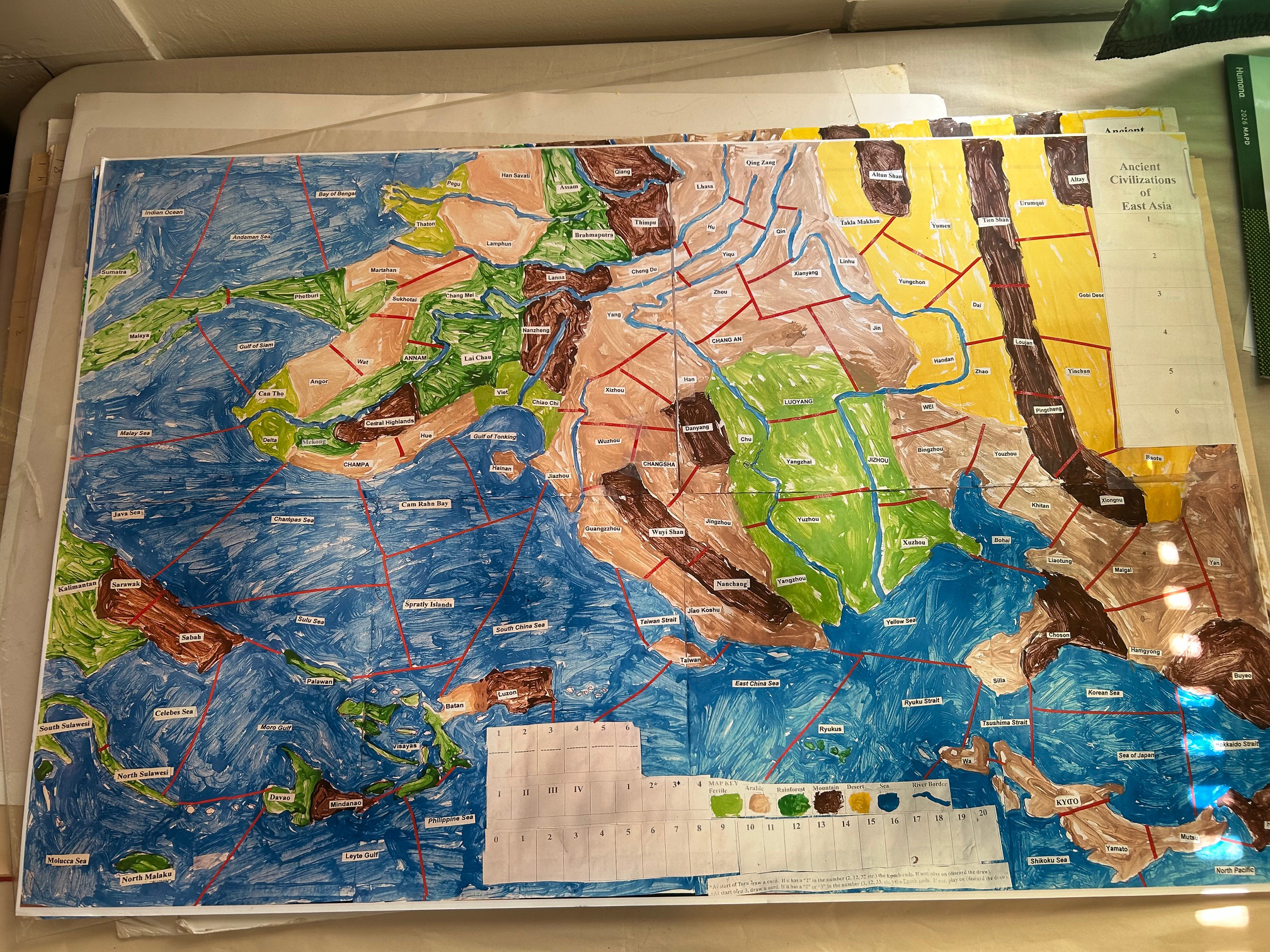
Figure 2: Japan’s initial placement of disks on ACEA’s playtest map: The “H” small wooden block indicates the Standard Game’s Japan Homeland, the Arable area of Kyoto which includes the island of Shikoku (the produced game’s component will be similar to ACME’s Homeland Blocks). Japan is one of the few ACEA Civilizations whose expansionist opportunities feature a nautical focus.
Without control of the Sea, Japan is relegated to remaining within its Homeland. But containing Japan can be quite the challenge since any other Civilization, e.g. from mainland China, seeking to control its surrounding Sea areas must contend with “The Divine Wind”.
Readers observing how small, nay “tiny”, the Ryuku Islands area is within the Ryuku Strait Sea Area and wondering how all the wooden disks and cardstock counters potentially placeable within a typical Ancient Civilizations of East Asia map area, particularly if by more than one Civilization, fit into the Ryuku Islands should take heart and not be concerned!
The upper right corner of ACEA’s map has an area for six “Off Map Pieces Overflow Boxes” organized in a Display. Each Box has an associated counter numbered 1-6, so to avoid potentially indecipherable map clutter, one of its counters, e.g. “Off Map Overflow Counter #1” is placed upon the Ryuku Islands area and all that small area’s contents, disks & any counters, are installed onto the Display’s large #1 Space. See: ACEA_Playtest_Map.jpg (2016×1512) Once ACEA receives a professionally rendered map, with its glorious and better than this playtest map’s graphics, visually distinguishing an area such as the Ryuku Islands should be much easier!
So we bid farewell to the Japan of Ancient Civilizations of East Asia. Next up in this “Meet the Civs” Series, we return to the Asian mainland for the impressive Han Civilization!
Previous Ancient Civilizations of East Asia “Meet the Civilizations” Articles