

As with its predecessors (Ancient Civilizations of the Inner Sea, GMT Games – Ancient Civilizations of the Inner Sea and Ancient Civilizations of the Middle East, GMT Games – Ancient Civilizations of the Middle East, or ASIS and ACME, respectively), the cards of Ancient Civilizations of East Asia, known as “Karma Cards”, quite literally “rule” the game.
These 110 cards come in eight “flavors” (or types). The single largest block of cards by type is the one which allow players to influence Competition. Although “Competition” is defined in the game system as being any kind of conflict or rivalry over an area of the map – economic, social, political, religious and/or military. But let’s face it, for most gamers: Competition Cards are WAR cards.
In the previous article we looked at “The Hateful Eight”, It’s all about the Cards: Exploring the Card Deck of Ancient Civilizations of East Asia (Part 2): – InsideGMT – arguably the most powerful subset of ACEA Competition Cards (and the ones that every player “hates” to have played upon them). In this, the second in the series on Competition Cards, we consider Karma Cards which have a common theme: Sieges and “Sudden Strike” cards.
First to the Siege Cards: There is no specific “siege” mechanism per se in any of the Ancient Civilization games. What “siege” refers to is the play of a card that prohibits or inhibits an opponent from using cards or paying taels (the money of the game) to buy off losses. These are almost always limited to areas in which the opposing civilization has at least three disks (which, by definition, is a “city” – and cities are prime targets, as removing their disks offers the winner both a victory point, loot (a tael or two disks of slaves to be placed upon the map next turn), as well as the possibility of influencing a Cultural Development Track disk of either the victor or vanquished civilization.
Siege cards are identified by an upper left corner letter “C”. Some of them can counter or remove strongholds (defensive counters equal to a disk in value). While field battles did occur in the areas and Epochs the game encompasses, sieges were far more common – in East Asia as well as in the parts of the world covered by the two previous entries of the Ancient Civilization series. The Chinese, in particular, were masters of the art of siege (except when confronted by the Korean Civilization, who were masters in the art of fortification).
For those readers unfamiliar with the “dice less” Competition procedure for resolving conflict in all three of the Ancient Civilization games, this extract from Ancient Civilizations of the Middle East’s Playbook provides examples, including use of Competition Cards: ACME_Playbook_56pp.pdf
Please note that all cards depicted by this article and those to follow are from ACEA play test game sets. Ah, but how glorious these cards shall appear with the wonderful graphics we’ve come to expect of GMT! Also note that all six of this article’s cards have quotes from the legendary military genius of Ancient China: Sun Tzu.
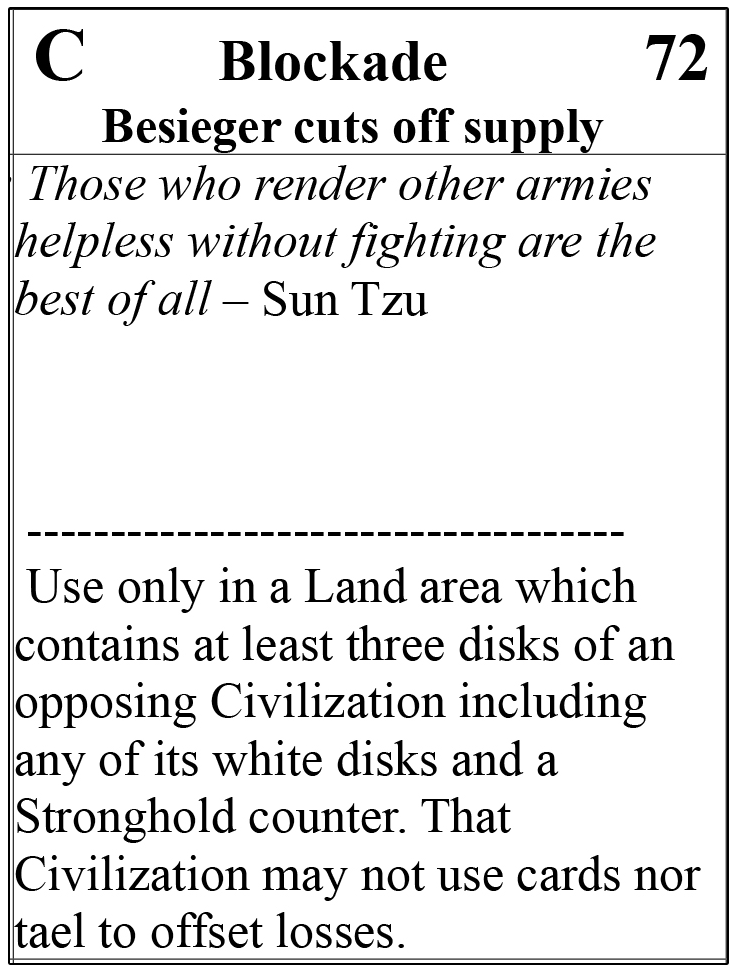
Card #72: Blockade
This Siege Competition Card represents the most basic form of siege warfare: cutting off the target from outside help. Normally a player can expend or use cards or taels rather than remove disks on a one-for-one basis. This potent card prevents that and forces the opponent to first remove any stronghold marker and then proceed to losing disks.

Unless countered (e.g. by Negation Card #98, Heresy) this almost always guarantees success as the card player can use their cards and taels to pay off their own required disk losses. Ah, how fondly the ACEA Team recalls a smugly confident player with a burgeoning treasury being humbled when an opponent plays the Blockade siege card against them.

Card #73: Siege
This is slightly less powerful than the Blockade card above, as it still allows a player to discard or use cards (e.g. instead of disks, but it is very useful against an opponent who has a large pile of taels – as it makes them worthless for this particular Competition. It won’t stop an opponent from negating a disk loss by removing a disk from an Investment/Competition Card such as #82, Cavalry Reserves.

Furthermore, if your opponent chooses to discard a card to offset a disk loss, it could signify a grievous momentum set back. For Karma Cards are one of a player’s “game life blood” elements.

Card #78: Siegemaster
This Great Person Card gives the card player an immediate advantage as it forces their opponent to remove a disk AND any stronghold counter in the area (which means, essentially, they must lose two disks). It also prevents the opponent from offsetting these TWO losses in any manner whatsoever (although it has no such effect on the second or subsequent round of Competition).
As any card, the Siegemaster can be negated, but as a Great Person Card, it’s vulnerable to Negate Card #19, Eunuch Coup, #24 Cike (Assassin), or #56, Poison. There are dangers to being a Great Person during a game of Ancient Civilizations of East Asia. More on the aforementioned during upcoming “It’s All About the Cards” episodes.
“Sudden Strike” Competition Cards
There are some Competition Cards which replicate sudden or surprise attacks (as well as feigned retreats) – military tactics favored by the legendary master strategist Sun Tzu. These cards also reflect a type of action which the swift, highly mobile, horsemen of the steppes perfected.

Card #86: Flank Attack
History is replete with successful outflanking maneuvers that caught an enemy off guard and struck them suddenly and decisively. This tactic knocked them off balance and put them at an immediate disadvantage.

The horse clans and mounted warriors from the north were particularly adept at running around the flanks, and even into the rear, of the more static armies of their enemies. Removing two disks (or at least forcing the opponent to decide whether to buy off those losses with cards and/or taels) at the start of a Competition can put an opponent at a disadvantage.

Card #87: Night Attack
A night attack has always been (and even with modern technology still is today) a dicey tactic. If it works, the results can be devastating – but if it fails (and a lot have) it can backfire upon the attacker. Thus, this card is a two-edged sword. It is a Competition Card which carries great risks as well as possessing great potential for inflicting pain upon one’s enemy.

Note the penalty for failure is a single disk from the card player, plus the card itself (which is worth one disk if discarded) while success eliminates three opposing disks of any color. Ah, but there’s another aspect of this card to consider, the need to pick the top card from the deck to determine whether the Night Attack succeeds.
If that is an Event Card and the card player has the least number of VP, it could provide an opportunity to inflict far more pain on an opposing Civilization than that of the Night Attack card itself. For example, triggering a Barbarian Invasion. To learn more of ACEA’s Event Cards, some good, most “evil”, see Part One of this series: “The Seven Deadly Events” – It’s all about the Cards: Exploring the Karma Card Deck of Ancient Civilizations of East Asia (Part 1) – InsideGMT.
Therefore, this card should not be used lightly – unless, of course, one feels lucky (or desperate).
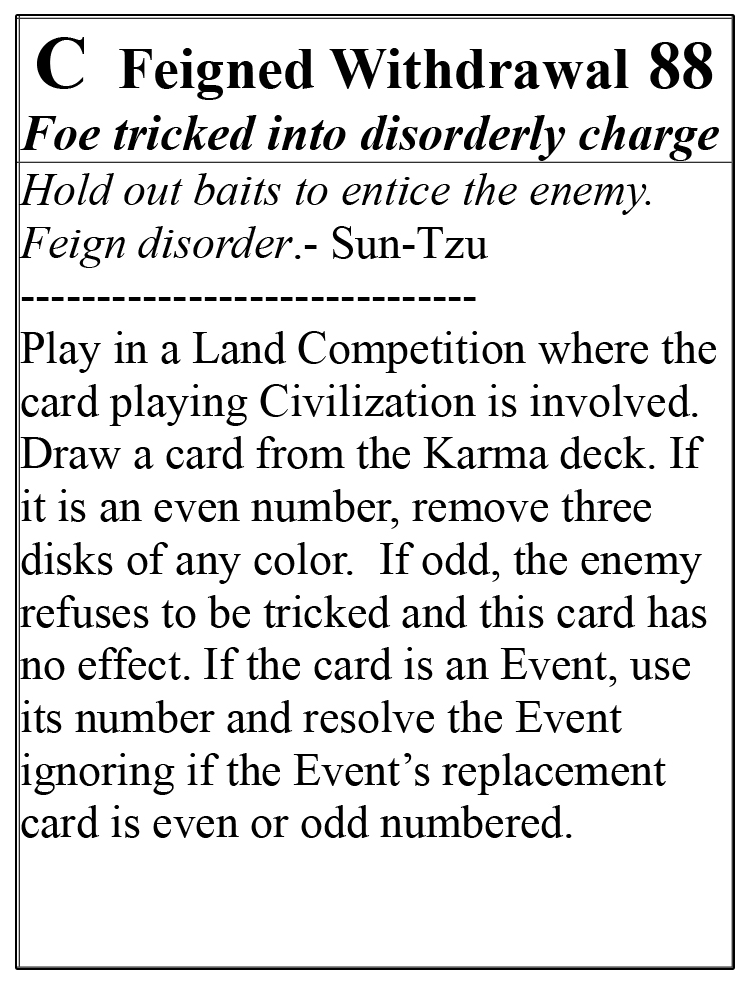
Card #88: Feigned Withdrawal
This was THE favored tactic of the Xiongnu, Huns, Mongols and almost every other mounted nomadic invader from the steppes of Central Asia. It almost always worked (almost” being the operative term).
Overeager generals could be easily fooled into thinking their enemy was running away – only to find themselves drawn into a trap. As with Night Attack, there is a chance that things can go wrong (not every enemy is so easily fooled) and as such it is just a wasted card – but the potential benefits of it succeeding, well, removing three enemy disks can pretty much weight the chances for victory, or even end the fight before it begins (unless, of course, the foe is willing to expend cards, use the disks of any of their Investment/Competition Card[s] and/or spend taels just to stay in the fight).

Then, as with Night Attack, Feigned Withdrawal requires a card to be drawn from the top of the deck to learn if the tactic works, and if it is an Event Card… suspense, eh?
Hopefully, the preceding, along with other InsideGMT material published to date, has piqued your interest in this latest game of the “Ancient Civs” series. To those now motivated to place a P-500 order for Ancient Civilizations of East Asia, Ancient Civilizations of East Asia, the ACEA Design & Development Team is most appreciative.
NEXT: Weapons and Warriors
Previous Ancient Civilizations of East Asia “Meet the Civilizations” Articles


