

Historical Background
The Vietnam War was a long and complex conflict—far too sprawling to model in full within a lane battler board game. Iron Triangle therefore narrows its focus to the struggle between U.S. and Viet Cong (VC) forces during the Military Assistance Command, Vietnam (MACV) driven search and destroy campaigns in III Corps Tactical Zone from 1966 to the Tet Offensive in 1968.
III Corps encompassed Saigon and the surrounding regions stretching north toward the Cambodian border. Within it lay the Iron Triangle, roughly 30 km northwest of Saigon, a strategically vital stronghold for Communist forces. Dense jungle, thick undergrowth, and extensive natural cover made the area exceptionally defensible. Beneath it ran a sophisticated network of tunnels that allowed the Viet Cong to store supplies, move undetected, and launch surprise attacks. Its proximity to the South Vietnamese capital enabled the VC to threaten key roads, disrupt supply routes, and strike directly at Saigon.

Map of III Corps, including the Iron Triangle and War Zones C and D
In 1966, MACV shifted U.S. doctrine toward a strategy of attrition: the belief that the Viet Cong could not sustain heavy losses and that grinding down their forces would create the stability needed for the South Vietnamese government to function effectively. The VC, by contrast, aimed to prolong the conflict, eroding public confidence in that same government. These opposing strategies collided in the Tet Offensive—a watershed moment. Although Tet was devastating for the VC militarily, it revealed to the United States that sheer force could not break a determined and deeply rooted movement.
Iron Triangle aims to reflect the cat-and-mouse, deadly game of hide-and-seek dynamic that defined U.S.–VC operations in the region. The mechanics focus on uncertainty and misdirection, creating a constant sense of one side probing while the other evades, conceals, and strikes when the moment is right.
Victory Conditions
A game of Iron Triangle can end in two ways: a decisive victory, achieved when either the U.S. or VC meets its specific objectives, or a final resolution during the Tet Offensive—a bag draw influenced by the end-game board state.
U.S. Early Victory
For a U.S. decisive Victory, they must expose and eliminate VC units while maintaining regional stability. This is done by playing action cards against Operations to manipulate tunnelled and concealed VC cards, revealing symbols that can be attacked. Each successful hit advances the attrition marker along the main track. If the marker reaches the end, the U.S. has—true to MACV’s intent—reduced VC effectiveness to the point where they can no longer pose a serious threat in the region.

Prototype VC action card (not final graphics)
However, attrition alone is not enough. The U.S. must also sustain stability across the region. Control gained in the three region tracks through successful search-and-destroy operations shifts the stability marker on the tug-of-war Stability track. If the U.S. can maintain sufficient stability while meeting its attrition target, it secures an early victory.
VC Early Victory
The Viet Cong player aims to reduce public confidence in the South Vietnamese government by destabilising the region. This is achieved by successfully disrupting US operations, inflicting heavy defeats and maintaining territorial control. This reflects their strategy of elongating the conflict to ultimately undermine the perception of the government’s ability to provide security and stability.
If the VC player can destabilise the region and reduce the public opinion marker to the final space on the Public Opinion track they will claim victory.
Tet Offensive Victory
If neither the VC nor the South Vietnamese–U.S. coalition has secured victory by the end of the third round, the conflict’s outcome is determined through a Tet draw, reflecting the uncertainty and political tension that surrounded the real build-up to the 1968 Tet Offensive. The draw bag begins with three Tet tokens for each faction, representing the baseline preparations both sides had in place as the war entered a critical phase.
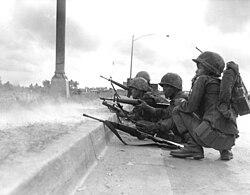
ARVN Rangers defend Saigon during the Tet Offensive.
Throughout the game, the VC player can increase their influence in the bag by infiltrating Saigon via refugee generation tokens, echoing how Viet Cong operatives historically moved among displaced civilians to position forces near key urban centres. Additional Tet tokens are added at the end of the game based on the final positions of the Control markers and the number of surviving Tunnel bases— indicators of the VC’s ability to coordinate a large-scale, politically disruptive offensive.
Once the bag is prepared, the VC player draws five tokens. Each VC token drawn reduces South Vietnamese Public Opinion by one step. This represents the shock, fear, and crisis of confidence that spread among South Vietnamese civilians and officials during the real Tet Offensive, when the sudden eruption of coordinated attacks undermined faith in the government’s ability to maintain security. If Public Opinion reaches or surpasses the final space, Tet is judged a success: the South Vietnamese population loses confidence in their government’s stability, mirroring the political upheaval that followed the historical offensive. If the threshold is not reached, the coalition has successfully contained the threat of a major uprising and claims victory.
The Board – Main Tracks
Iron Triangle utilises a map board to track the effect of Operational outcomes, from control, attrition, stability, and public opinion to Saigon, bases, and VC resources. This rest of this article will focus on the main tracks and how they impact the game.

Prototype game board (not final graphics)
- Control Tracks
The game’s three Control tracks reflect the key regions where U.S. and ARVN forces concentrated their search-and-destroy campaigns in III Corps during this phase of the Vietnam War: War Zone C, War Zone D, and the Iron Triangle. Each of these areas was a long-standing stronghold of Viet Cong activity, shaped by dense jungle, hidden tunnel networks, and shifting front lines. As players win Operations, their gains are recorded along these tracks, representing the gradual—and often fragile—extension of military influence.
Players can establish bases on spaces adjacent to the Control marker. Historically, these bases mirrored the firebases used to project power deeper into contested territory and tunnel bases utilised by the Viet Cong to launch surprise attacks. In the game, they either hinder enemy advances or support your own, depending on how they are positioned.

Close-up of Iron Triangle track (not final graphics)
The Iron Triangle track is intentionally shorter, reflecting the compact size of this real-world VC sanctuary just northwest of Saigon. Despite its smaller footprint, it exerts a stronger influence on overall Control because of its strategic proximity to the capital and its historical role as a staging ground for major offensives.
Control tracks also become crucial if the game reaches a Tet Offensive conclusion. Final positions on each track determine how many Tet tokens players add to the bag, representing the hidden build-up of forces and the uncertainty that defined the lead-up to the 1968 nationwide attacks.
- MACV Track
Running along the edge of the board, the MACV track represents the effectiveness of the US strategic effort. It records Attrition as well as the overall Control situation, with the combined total from the three regional Control tracks shown by a double-sided marker—US on one side, VC on the other. This single token captures the shifting momentum of the conflict, making the MACV track a quick visual read on who currently holds the upper hand.

Close-up of MACV track (not final graphics)
- Stability
At the close of each round, the total Control across all three regional tracks is recalculated, shifting the Main Control marker along the MACV track. Its position directly affects the region’s overall Stability, recorded on the Stability Track. This reflects how gains or setbacks in different regions shaped wider political and military confidence during the conflict.
Stability then feeds into two key gameplay consequences: it determines how many Caches the VC player receives as North Vietnam adjusts the flow of resources along the Ho Chi Minh Trail, and it influences the US player’s hand size. In both cases the VC or U.S. player is rewarded with more support as the situation worsens for them, reflecting the commitment of additional resources to III Corps.

Close-up of Stability track (not final graphics)
- Public Opinion
Most importantly, Stability drives changes in Public Opinion: as conditions on the ground deteriorate or improve, the Public Opinion marker rises or falls. Should it ever reach the lowest space, the growing discontent triggers an immediate VC victory.

Close-up of Public Opinion track (not final graphics)
In the next article in this series, we will take a closer look at the deck of action cards used by each player, as well as the operation cards that they will be fighting over.

Author: Darren McGuire

Looking forward to seeing more pictures of this (Iron Triangle).