

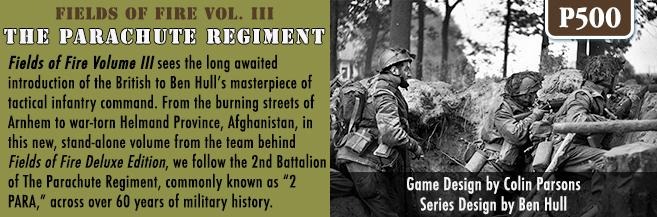
As Fields of Fire III nears completion, this series of Inside GMT articles will take a deep look into each of the campaigns and showcase some of the new features and generally introduce the game for those who have never played Fields of Fire before.

So, what comes in the no-doubt massive (yet to be completed) box?
Besides the 96-page spiral-bound rulebook, that will be updated with clarifications here and there and also downloadable from GMT website (sans spirals), the centrepiece of this game will be the three mission books. 26 missions follow the British 2nd Battalion, Parachute Regiment from Market Garden in 1944, through the Falklands conflict in 1982, up to the (relatively) modern theatre of Helmand, Afghanistan 2008.
As in previous volumes, the missions highlight the development in technology over time, not only of weapons, but also communications. For those familiar with Volume 1, 1944 begins with radios somewhat the equivalent of the handie-talkies that the US army were provided with in the Normandy campaign, but actually less reliable, and concludes with communications capabilities far surpassing those in the Vietnam campaign. Of course, this is a Command and Control game at heart, so we have made sure to focus on other C2 challenges as the ability to talk to your units improves.
The volume as a whole demonstrates changes in the way war is fought. From the total war battlefield that is the blazing ruins of Arnhem, through to the modern era where distinguishing the enemy from the civilian population is vital and each casualty you take will be scrutinised by the world’s press.
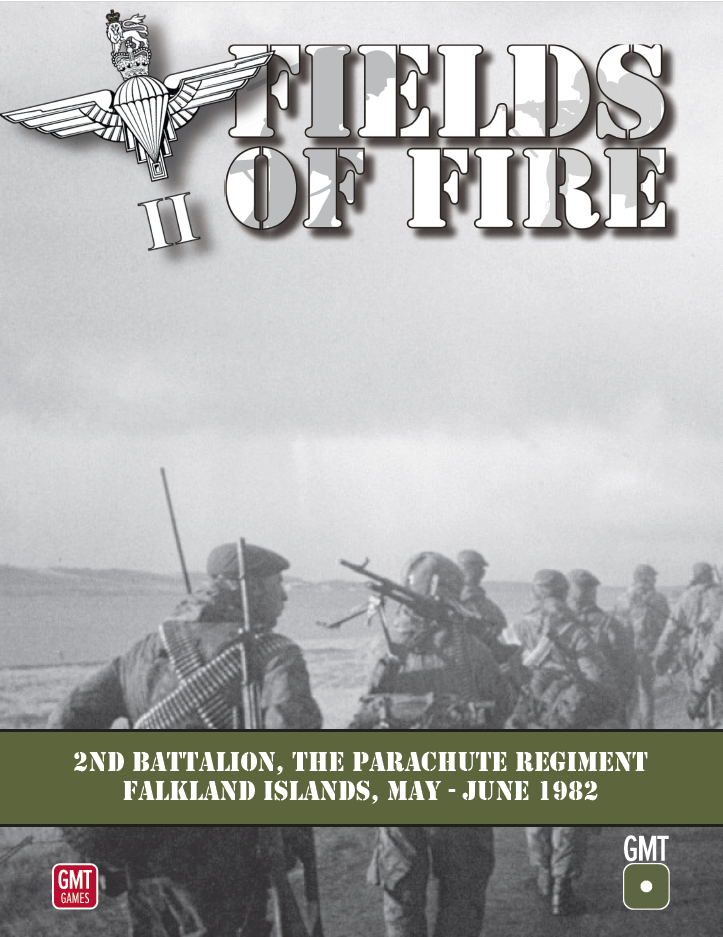
Campaign 1 – Falklands 1982.
Outline
Two campaigns (Battle of Goose Green, Battle of Wireless Ridge), nine missions total.
Basic Concept
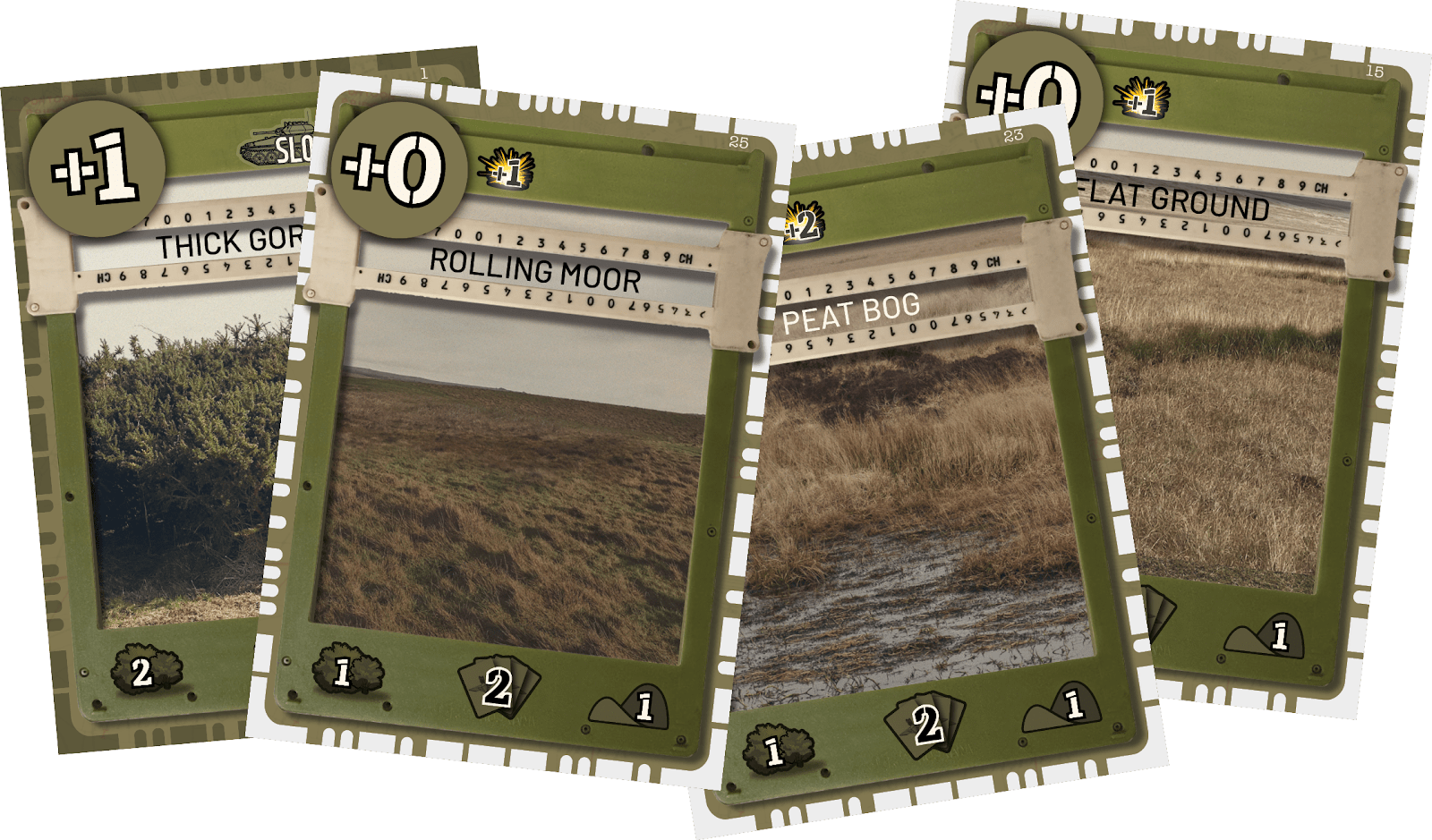
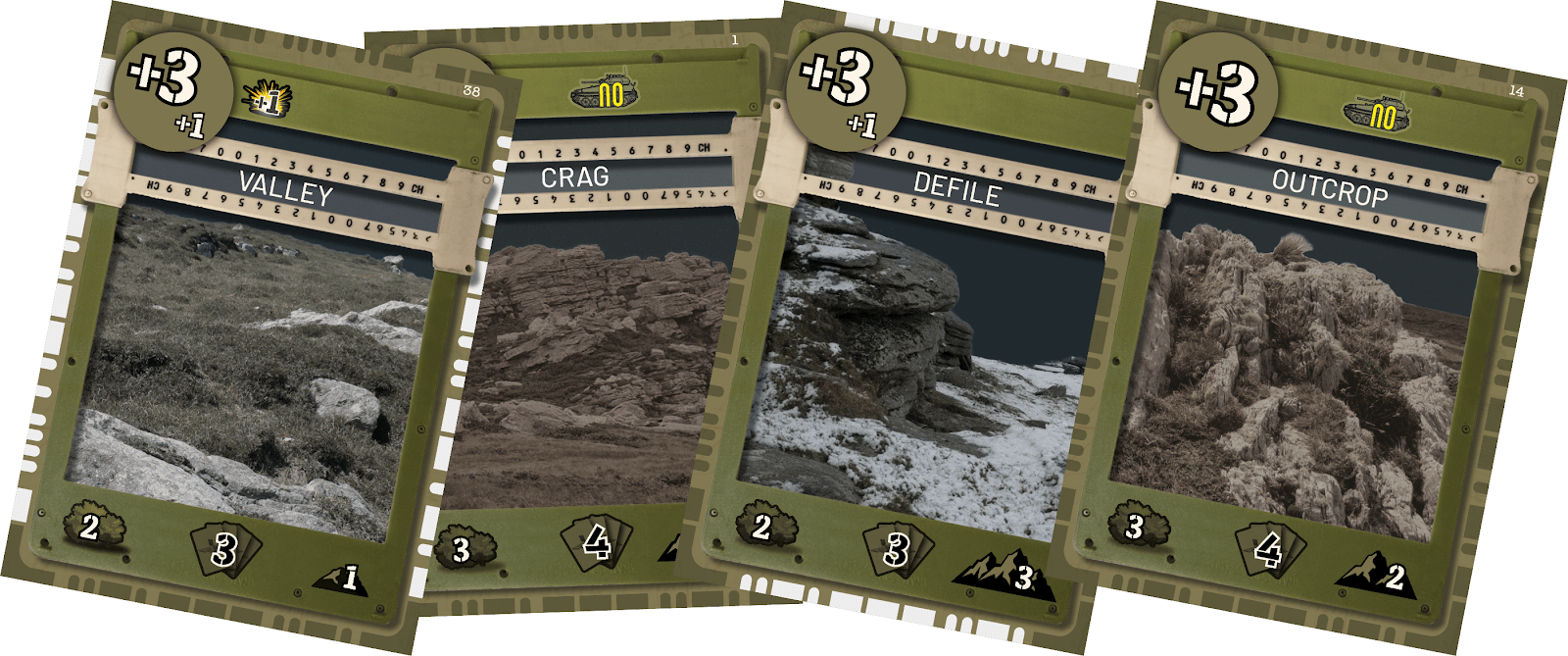
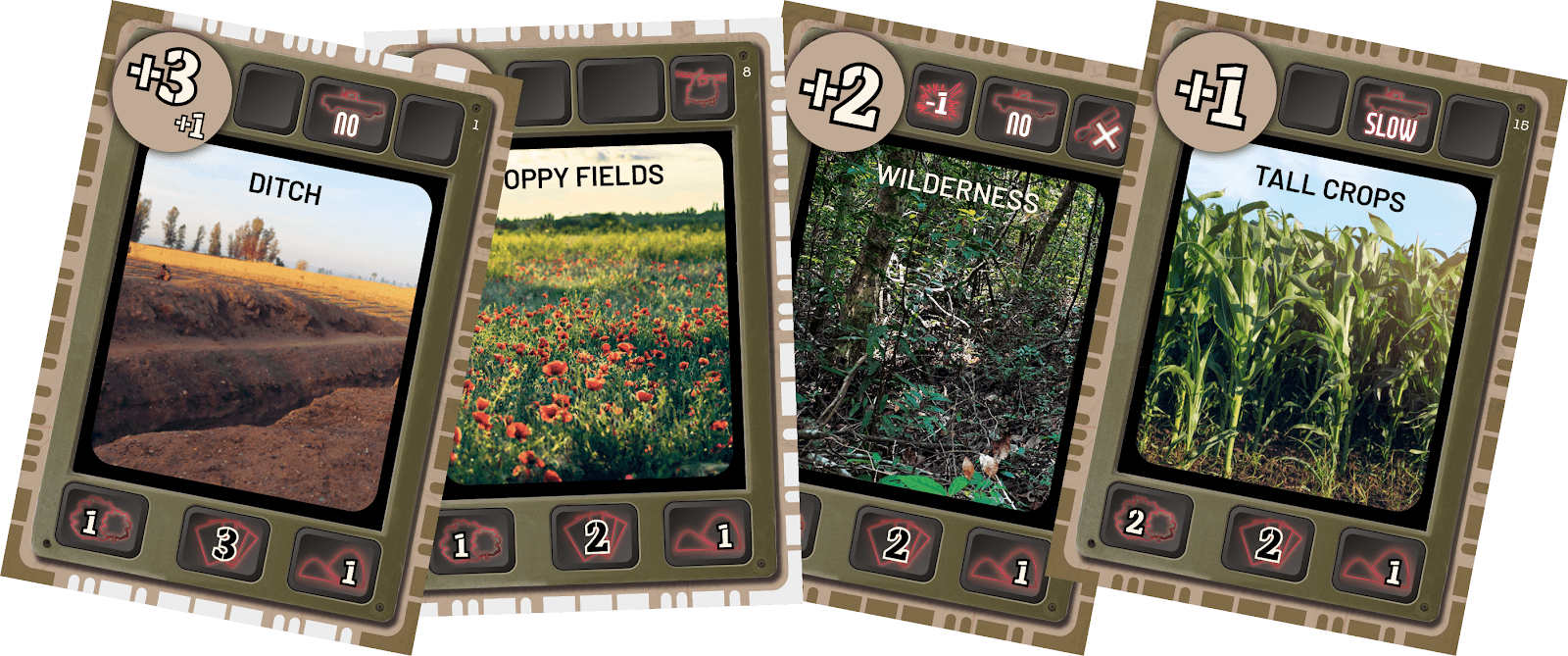
Overall, the Falklands campaign is the closest to the missions in Fields of Fire volume 1 and we recommend this as a good starting point to explore the Parachute Regiment, rather than tackling the campaigns in chronological order. Communications are comparable to the Vietnam campaign, but with additional flexibility in each of the squads (or Sections as they are known in the British army). Each campaign uses its own terrain deck to represent the difference between the flat, almost featureless ground of the approach to Goose Green and the rocky, mountainous terrain of Wireless Ridge.
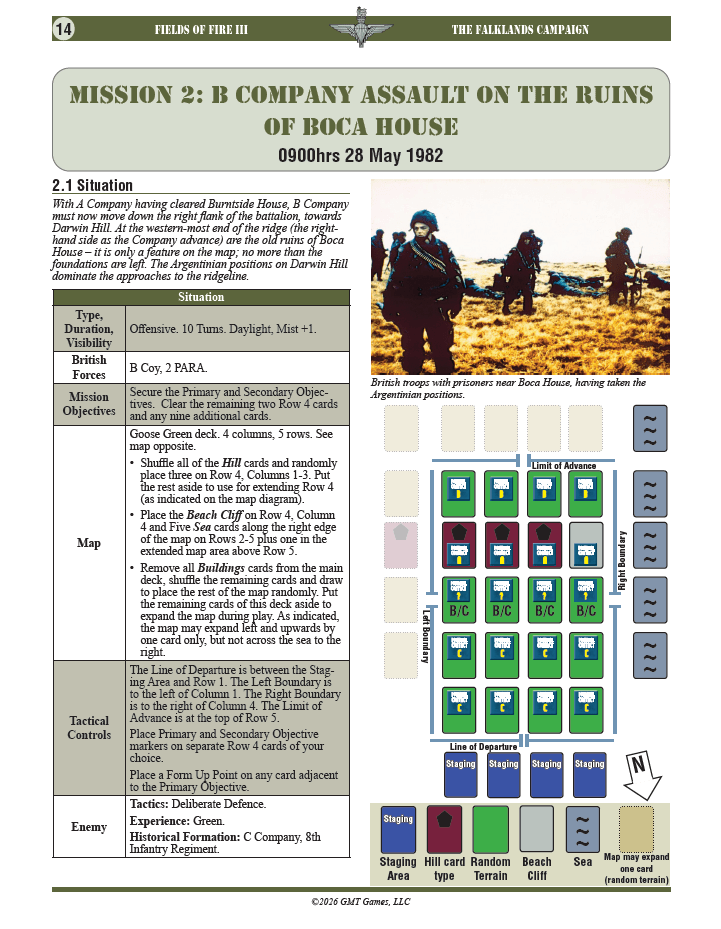
Key Points
- Straightforward “capture the objective” missions (plus one limited Defensive mission).
- Relatively simple communications between HQ units and Section units, thanks to modern radios.
- Extensive use of Limited Vision and Night Observation Devices rules (Wireless Ridge).
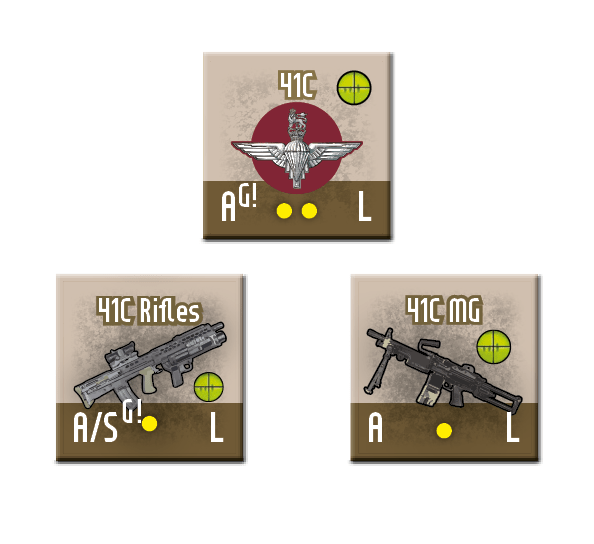
- Multi-unit counter sections that can be ordered as a pair or separately to reflect increased flexibility through modern communications.

Examples on the use of modern radios and multi-unit sections are included in the Training Pamphlets.
Events reflect various historical happenings of each battle, including the possibility of Battalion Commander Lt-Col ‘H’ Jones leading an ill-fated assault on a fortified enemy position.
Campaign 2 – Arnhem 1944.

Outline
One 8-mission campaign divided into standard Offensive and Urban Combat Defensive missions.
Basic Concept
The Arnhem campaign is divided into two distinct parts. The initial approach to Arnhem is played on regular terrain cards as the light, but well-armed parachute company makes their way through the Dutch countryside. The remaining missions take place on Urban Combat cards using the full Urban Combat rules plus additions such as fires and collapsing buildings.
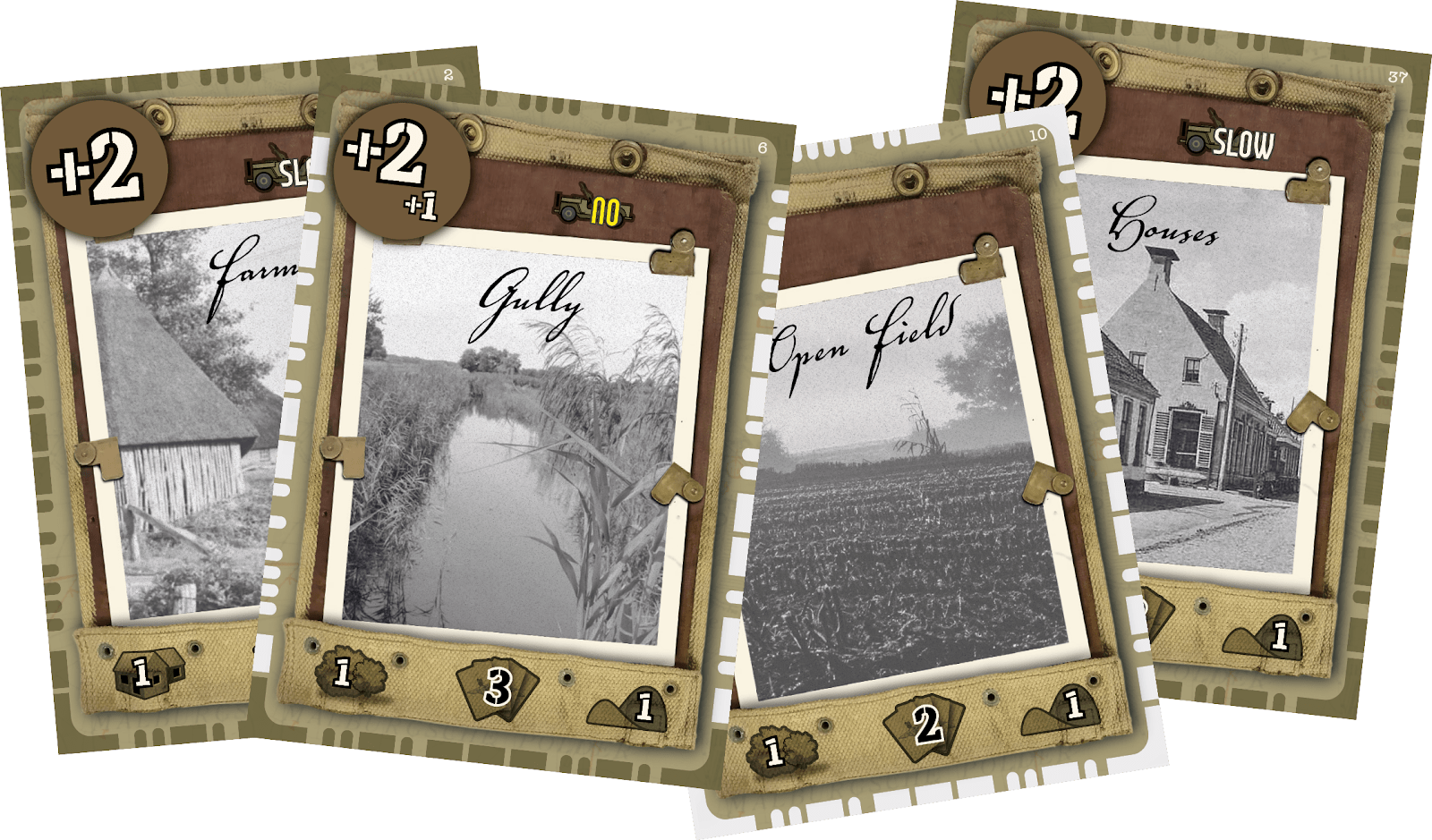
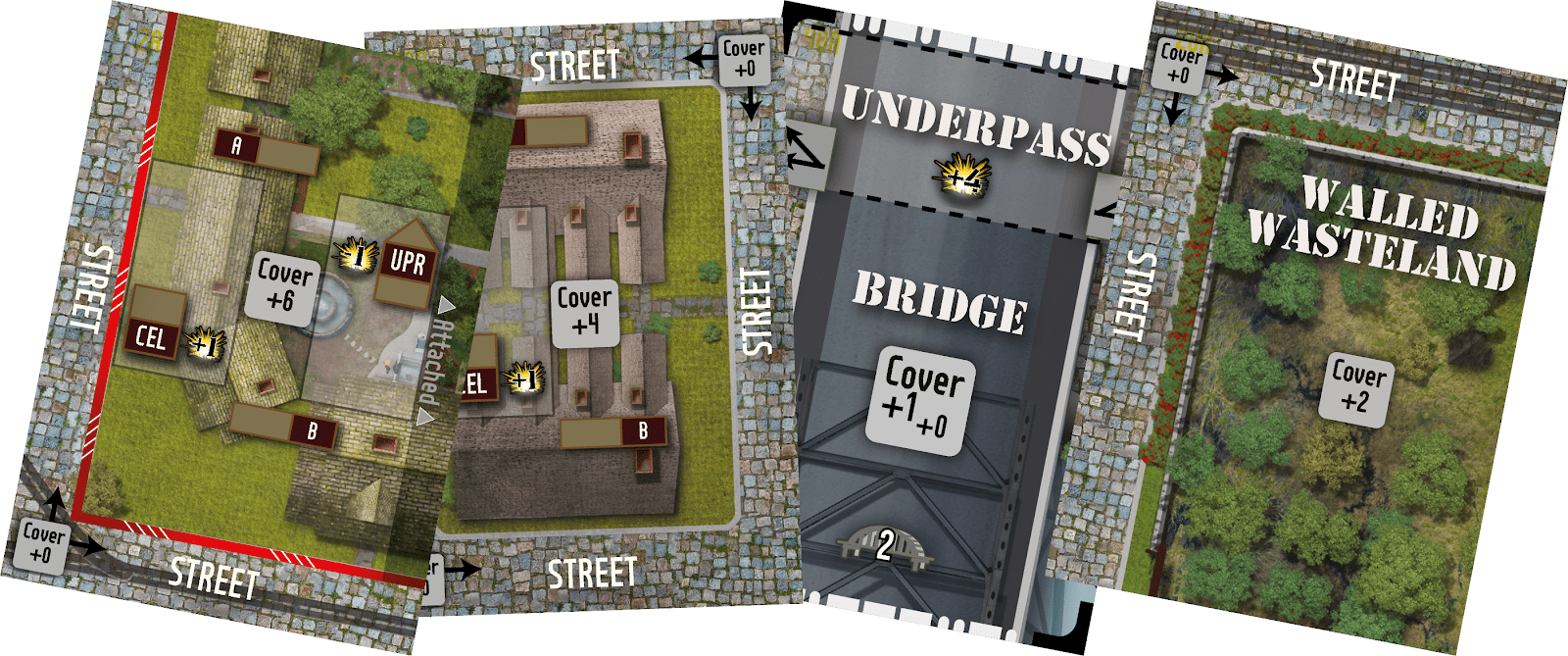
Key Points

- Greater emphasis on Runners as radios prove as unreliable as they were historically.
- Addition of Bugle communications.
- Urban Combat Defensive missions. A first for the Fields of Fire series. Enemy units will act in ways that you will find unfamiliar as they attempt to break through your perimeter with every weapon at their disposal.
- Light mortars for all sections with smoke to facilitate quick movement to (or away from) enemy positions.
- 2-sided cards for the Urban deck to represent the incremental destruction of the city during the battle.
- Units from other companies will join the fight as the situation in Arnhem becomes increasingly desperate.

Urban Combat is about as complex as the Fields of Fire system gets. Extensive training, including assault courses, stand alone missions and an extended example of play are included to help ease you into the campaign.
Campaign 3 – Afghanistan 2008

Outline
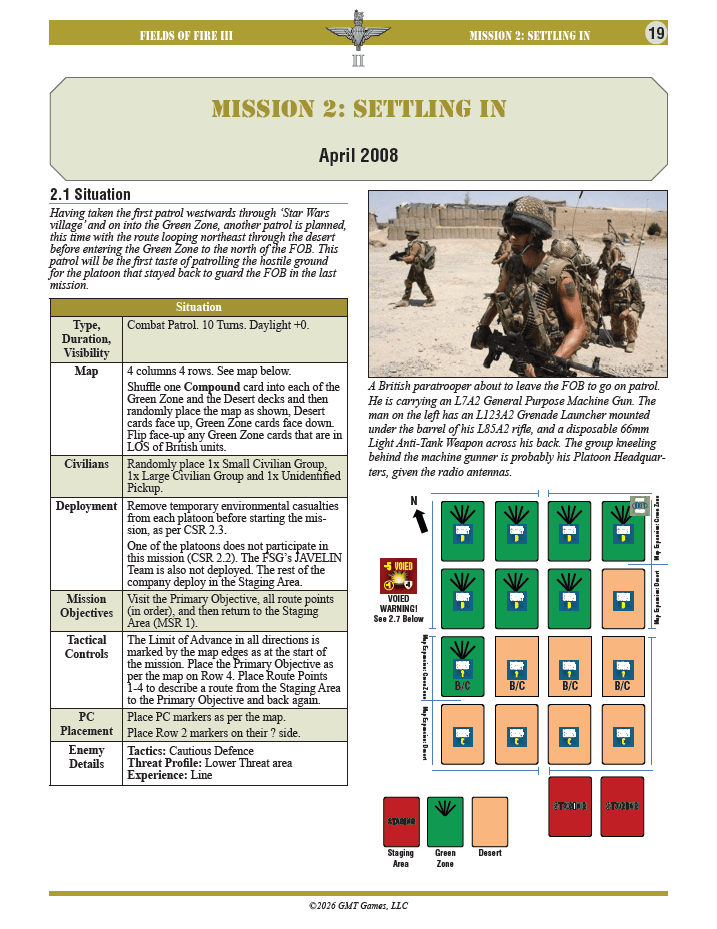
One 8-mission campaign with maps built from two terrain decks representing the desert areas and Green Zone around Forward Operating Base Inkerman where 2 Para were based for 7 months.
Basic Concept
And now for something completely different. While the basic gameplay remains the same, the Afghanistan campaign sees you patrolling areas with roaming unidentified groups and vehicles. Identify these, avoid IEDs through careful detection and when the inevitable Taliban ambush occurs, engage, but avoid civilian casualties. The world is monitoring your conduct carefully.
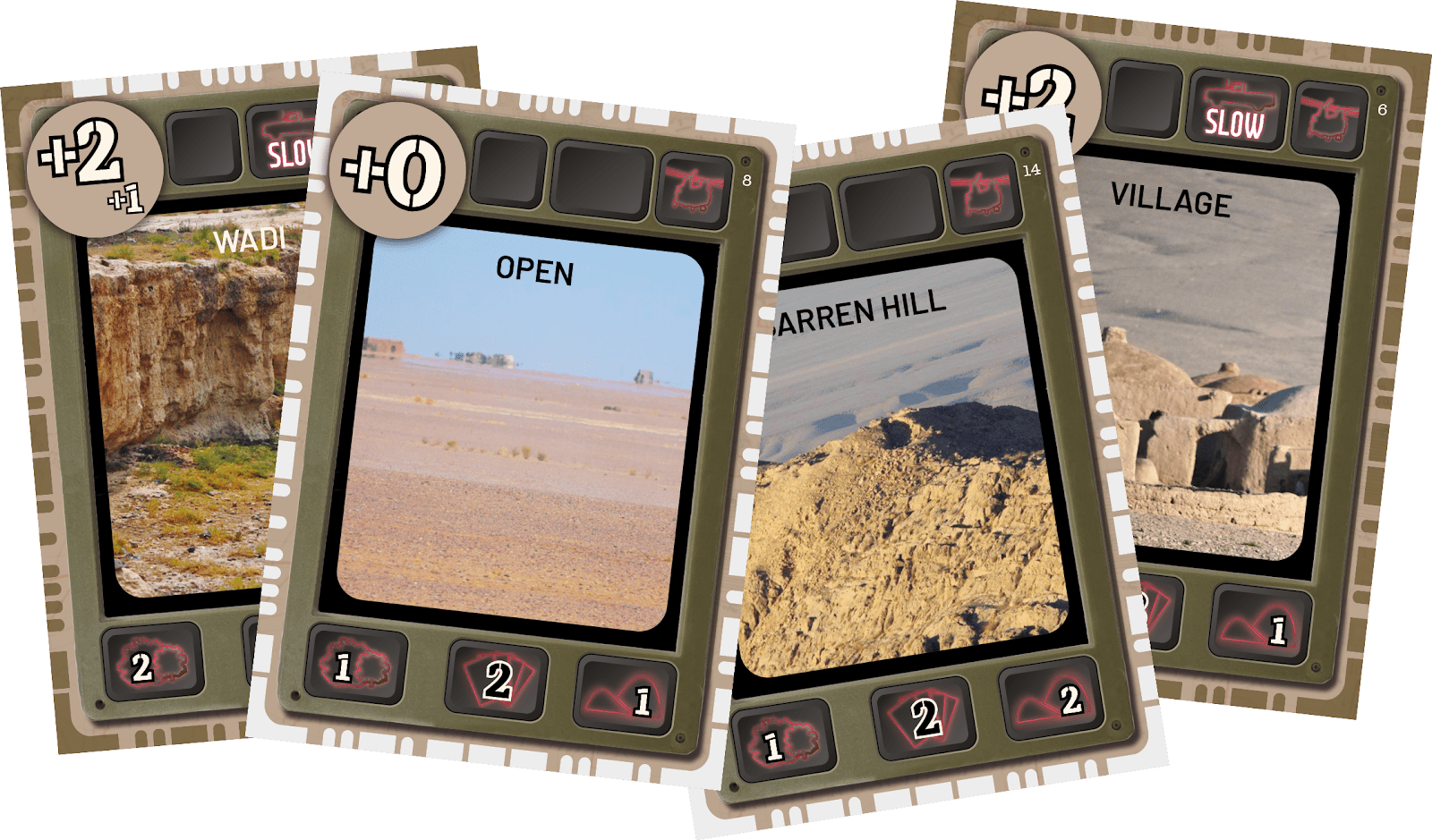
Key Points
- Civilians and Unidentified units make their way through the map innocently (or not), with a new segment in the Sequence of Play to check their behaviour.
- Vehicles on both sides (with training courses available).
- Stricter rules on minimising casualties and ensuring the timely evacuation of any that do occur.
- Units and equipment dedicated to detecting IEDs
- A generally slower, but much more tense approach to missions due to the uncertainty of potential danger.
Take your time to read through the situation and what is expected of you. Surging across the map in a typical WWII manner has resulted in plenty of playtesters finding their companies quickly eliminated by IEDs, suicide bombers and the occasional goat farmer who turned out to be concealing an RPG in his pickup.
Extras

Fields of Fire III comes with all of the player aids found in Fields of Fire Deluxe plus an Urban Combat focussed Enemy Activity chart. There is also a campaign map to track damage between missions for the Arnhem campaign and a player aid for tracking civilian and unidentified units in the Afghanistan campaign.
You’ll also find a Stand-Alone mission book with a Starter Mission, and, for more advanced players, a series of Offensive Urban Combat mini-missions.
Three Training Pamphlets guide you through the absolute basics of gameplay through platoon and company assault courses similar to those found in Volume 1. In addition, an Urban Combat Training Pamphlet provides an enhanced version of Chapter 13 with rules and examples focussed entirely on fighting in Arnhem, a set of training missions to learn the basics of moving around Urban Combat cards and assaulting enemy buildings and an extended example of play.

End of Part 1.
In Part 2, I’ll pick up the Falklands campaign, take a close look at our company and set out for Goose Green.
-Andrew Stead
Fields of Fire Series Developer

Author: Andrew Stead

Wow, the amount of content is double in comparison to Vol.1 Deluxe – double decks for campaigns, double-sided terrain cards, additional rules and aids. And I am not even sure which campaign excites me the most – Afghanistan with its civilians, Arnhem’s urban combat, or the atmospheric Falkland. If I could make a wishlist for the further expansions it definitely would be urban combat (maybe in Afghanistan or Iraq?)
N.B. Please also offer backup counter sets with FoF games ’cause a single lost unique counter might break the game (and sometimes you just can run out of status counters anyway)
Very intriguing look at what will certainly be a great addition to the growing Fields of Fire collection. I’m working through my first Normandy campaign in FOF Deluxe.