

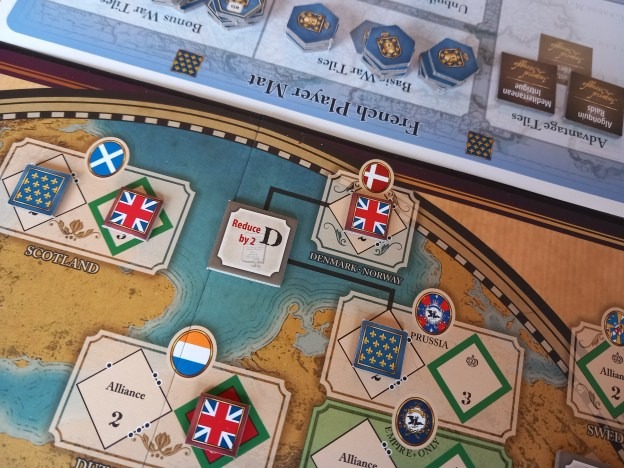
Below you will find another excellent article from Clio’s Board Games, this time featuring a playlist they created to go along with Imperial Struggle. You can also read Clio’s original article here. Enjoy! -Rachel
—
You love board games. You probably also like music. Let’s combine the two into an immersive playlist for Imperial Struggle. Have it gently play in the background during your next session of Imperial Struggle for the full period immersion!
First things first: Here’s the playlist!
Before we dive into the content of the playlist, some general observations:
- Of course, there was no music recording in the age of Imperial Struggle, so all the songs in the playlist have been recorded in the 20th or 21st century.
- The playlist is only 1:45 hours long, so you might need to listen to it several times during your game… unless France stomps over Britain in the first turns.
- The playlist is thematically sorted. That helps you find similar songs, but makes for somewhat monotonous listening (until you come to the next group of songs). I therefore recommend you turn shuffle on.
Now, what awaits you in the playlist?
#1-3: Religious (classical) music
Imperial Struggle begins after the age of the great confessional wars in Europe, but religion still played an important role in people’s lives, from the lowliest peasants all the way up to kings. Their week culminated in a Sunday service and their year was interspersed with religious events. Composers wrote pieces specifically for a religious holiday (like Bach’s “Christmas Oratorio” from which #2 is taken), or were dedicated to comprehensive religious teaching (like Händel’s “Messiah”, premiering on Easter 1742 in Dublin, from which #3 is taken).
#4-12: Secular (classical) music
The Baroque saw music as universal. Religious and secular followed the same conventions, and thus the same composers wrote pieces for the church and for worldly courts, like Baroque grandmaster Johann Sebastian Bach (Toccata and Fugue in D minor, #4 and Cello Suite No. 1 in G Major, #6) or Georg Friedrich Händel (Sarabande from Suite No. 11, #5). The classical (in the narrower sense) music from the mid-18th century left this universal view behind. Composers now focused on either one or the other, with most of them following the more fashionable and more lucrative secular path.
Some composed for a court whose lavish entertainments always required music (like the 1773 wedding of the French prince Charles Philippe, the later king Charles X, for which François Francœur arranged the music from which #9 is taken – thus the title Symphonie du Festin Royal (Symphony of the Royal Feast)). Others became freelance musicians (like Mozart, who could (for some years) live of the proceeds of his concerts and operas, #10-12).
#13-16: Folk songs
Not everyone went to a church where the latest compositions were played on Sundays, and of course most people were far removed from attending any court festivities, let alone royal weddings. But people made and listened to music. The easiest, most affordable way to do so was to sing. The 18th century is rich with folk songs, some originally written at the time (like Frère Jacques (“Brother James”), #15 or “Ye Jacobites by Name”, #16), others older, but first put down to paper at the time (Au Claire De La Lune (“By the Light of the Moon”, #13, and Over the Hills, and Far Away (#14)).
#17-23: Patriotic songs
We’ve heard in #16 already how political events seeped into popular songs. Others were written specifically to rouse patriotic feeling, an emotion which came into its own in the 18th century: “Rule, Britannia” (#17) expressed confidence and pride in the Royal Navy to protect British freedoms, “The British Grenadiers” (#18) praised the courage of their counterpart by land.
That these songs could be re-interpreted and turned against their original intent shows “Free America” (#19), written in 1770, which uses the same tune as “The British Grenadiers”, but its lyrics extol America’s freedom (which turned out to be freedom from Britain).
Finally, national anthems also came first into existence in the 18th century: Brits sang “God Save the King/Queen” (#22 – I took the liberty of choosing a not-quite-traditional version). France only got its first anthem (La Marseillaise, #23) with the French Revolution which bookends Imperial Struggle… at least until Ananda Gupta and Jason Matthews get around to do a Revolutionary and Napoleonic Wars expansion!
Thanks to Jason for suggesting songs #5, #14, and #21!
If you like immersive playlists, I’ve done one for Weimar: The Fight for Democracy (Matthias Cramer, Capstone Games/Skellig Games/Spielworxx)!
If you want to dive a bit deeper into the times of Imperial Struggle, here’s a book recommendation.
And if you’re looking for strategic direction in Imperial Struggle, I’ve also got you covered.
What’s your favorite song from this playlist? Let me know in the comments!

Author: Clios Board Games
