

Introduction by Assistant Designer & Editor, Fred Schachter: Someone unfamiliar with our beloved gaming hobby might at first presume the first words of this piece’s title: “Humans Versus the French Bot” relates to a Terminator movie or some potential Gallic A.I. horror. Ah, but as InsideGMT readers know, this article is about Congress of Vienna, whose second edition is now being P-500 offered: GMT Games – Congress of Vienna, 2nd Printing
I had the pleasure of meeting this post’s author, Justin Penwith, through game mastering a Congress of Vienna “Learn the Rules / Play the Game” Session during a CSW Expo a couple of years ago. Justin had such a grand time immersing himself in the game that he was inspired to join our weekend CoV Group where variants and CoV game aspects are tested via Vassal Module.
One of those aspects was the group’s consensus that human players facing the French Bot had such an advantage, particularly during the late game and specifically with the 1814 “Desperate Times” Scenario, that France was doomed to lose. Not much fun, eh? Therefore, the following prospective CoV Playbook change was agreed to as meriting testing. Would the French Bot now be more competitive and have a better chance in achieving a Congress of Vienna game victory?
Pg. 44, left column, Add red content: “21.1 Initial Phase (Step 1) The Initial Phase [10.0] is modified as follows: “In a game where one or more human opponents play against the French Bot, when resolving an Initial Situation Card during General War, if the French force pool has 8 or more French units, place the French Recruitment Issue on the French Chair.”
Consequently, this article is Justin’s After-Action Report of a currently underway game he is participating in against the French Bot. This is a report of its first turn (CoV Turn 8, Nov.-Dec. 1814). Justin played Austria, Designer Frank Esparrago Russia, and CoV Team stalwart, David Schoellhamer took the role of Britain. If needed, this 1814 “Desperate Times” game will have a fourth Optional 11th Turn (see Cov Rulebook Section 15.4 Sudden Death Time Limit).
So, here’s Justin’s Report of a tense, exciting, enjoyable and entertaining possibly four-turn experience. Will, or can, the French Bot prevail? With that, take it away Justin!
Setting the Stage
Over the past seventeen months, Congress of Vienna has risen in my estimation to become tied as my favorite board wargame of all time. Playing it, almost weekly, via its Vassal Module or face-to-face, the more I play, the more I realize how deep the gameplay truly is. What challenging fun!
However, as I played solo versus both the French and Allied Bots, I realized there was a variation of game play that we had not playtested nor discussed. I mentioned this to the team a couple of months ago and we have since played scenarios where two or three human players faced a beleaguered French Bot which seemed to our CoV experienced veteran players, all too easy to defeat.
After several turns of various game sessions, we focused attention on the 1814 Scenario 17.5 “Desperate Times”. As this is but a three-turn game and is a challenge for both France and the Allies, it made a great deal of sense to see how well the French Bot could defend itself. So, we commenced a game with the option of playing a fourth turn, per rule 15.4, should it prove necessary. This article is the first of a series of After-Action Reports of this game.
It was our group experience that during previous games’ Negotiation Phase, players knowledgeable of the French Bot’s programmed choices, were able to force France, via manipulation of its Bot, to expend too many of its much-needed military cards and/or keep France from winning Issues, particularly priority ones, critical to its success, namely French Recruitment and Future Government of France.
We therefore agreed to a minor change, a change not in the current Playbook, but one which if accepted will find its way into a future CoV Living Playbook: the French Bot, through a turn’s Initial Situation Card, now automatically gains its own Recruitment Issue under certain circumstances as seen in the introdution. This, we play testers hoped, would create a strengthened France that was more capable, militarily speaking.
Turn One of Our 1814 Scenario 17.5 “Desperate Times” Game: The Negotiation Phase
In our most recent session, during the scenario’s Turn 1, France, to our shock, handily won the Negotiation Phase and its 4VP, including some very helpful Issues. As Turn One is also a Replacement Turn, France gaining Recruitment and two Minor Country Issues provided it a much-needed infusion of units… including one U.S. Militia for The War of 1812 Box.
Nevertheless, the Coalition Team of myself as Austria, Frank as Russia, and David playing Britain, did secure FIVE (5!) Military Operation Issues. Consequently, where we failed diplomatically, Frank and I anticipated crushing the seemingly weak French Bot on the Central, Northern, and Italian Fronts.
As to David, any damage he could inflict as Britain upon France would contribute to our shared cause of caging that Corsican Ogre.
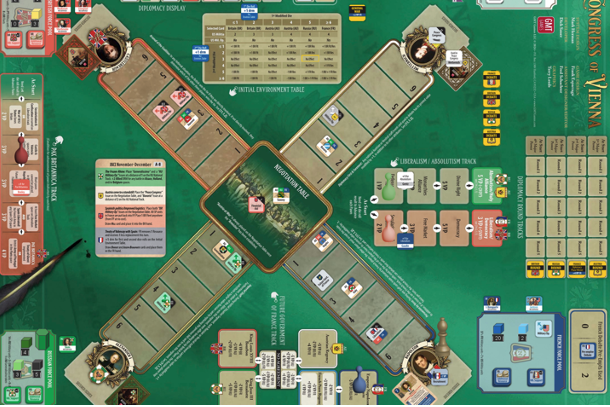
Figure 1: The end result of this Vassal Game’s Turn One Negotiation Phase with the French Bot Triumphant having five won Issues! It would Resource fund 4 of them, French Recruitment, Liberalism, and the Italy& Naples Minor Country Issues. Thereby leaving two remaining Resources for Military Support Markers.
France’s Diplomacy Phase victory is a far different outcome from our usual experiences to date. Before, France might have won but a single Issue, perhaps two at most. However, now that French Recruitment was resolved and automatically placed upon the French Chair during the turn’s Initial Phase, the “burning of French cards” yo-yoing of that high priority Bot Issue, with the Allies getting France to dance to their tune, could not occur.
During the Diplomacy Phase, there was a general effort among the three Allied players to grab the Future Government of France Issue, which Britain particularly needed to advance on its Pax Britannica Track. But between the choice of cards played to effect that and the French Diplomacy Track’s “stickiness”, the Allies just could not pull that off. France won that Issue, with no need to Resource fund it, and Napoleon remained emperor!
I did secure Peace Congress with Metternich for Austria, but the VP effects upon France were of no great consequence.
Britain was only too happy to allow France to also win the Absolutism/Liberalism Issue for its “Free Market” 3VP award to each, much to the chagrin of Russia and Austria.
Turn One of Our 1814 Scenario 17.5 “Desperate Times” Game: The War Phase
Where the French Bot shined even more was during the Nov.-Dec. 1814 Turn’s War Phase.
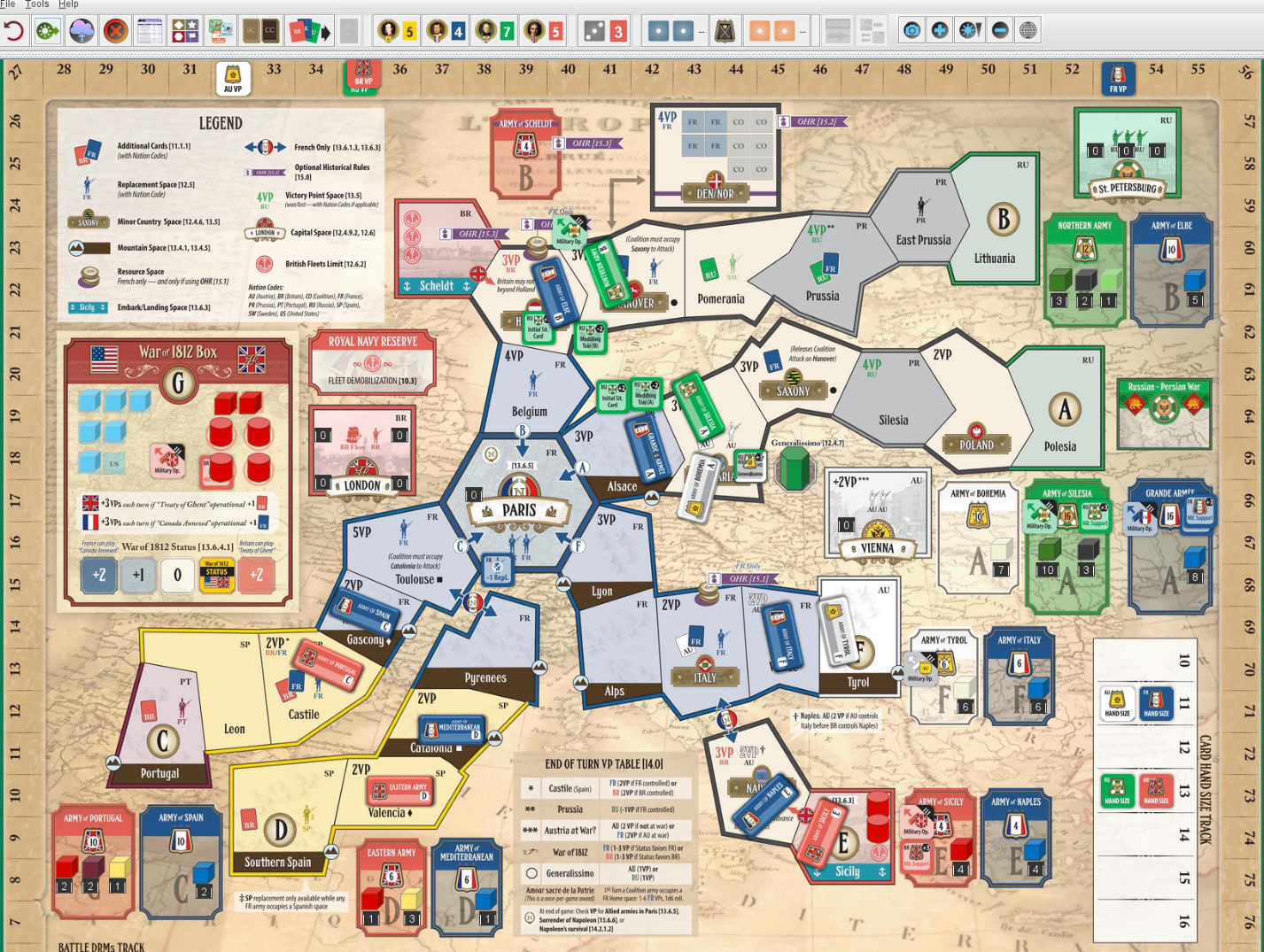
Figure 2: The Strategic Situation at the start of the game’s first War Phase. Russia is now Generalissimo. On Central European Front A, the Coalition was particularly confident of victory with their Military Card advantage combined with 20 Allied units facing the Grande Armee’s 8! Furthermore, overall, France had but a single Military Card other than Napoleon vs. 17 Allied Cards! Things certainly appeared grim, grim indeed, for the emperor and his cause. Ah, but read below to learn what transpired!
In this scenario, France does not have its forces well-positioned at game start. In the past the Bot often performed poorly against two or three human opponents. However, with this contest’s guaranteed Recruitment Issue to France, combined with two won Minor Country units and the fruits of a replacement turn, the Allied Players had to contend with these and their resultant units as well as the Bot’s potentially dreaded benefit of “Fog of War” cards. To learn more of the “Fog of War” Rule, see the CoV Playbook’s Section 23.1 Fog of War.
Fog of War cards can go either way or provide no advantage at all, but in this game, such was not the case. Far from it!

Figure 3: Woe to the Coalition! This is the situation at the end of the first turn. Note that beleaguered France remains in the VP lead with Britain closing in, albeit 18 VP behind. Congress of Vienna provides opportunities for many a VP scoring swing, so the final game outcome remains in doubt.
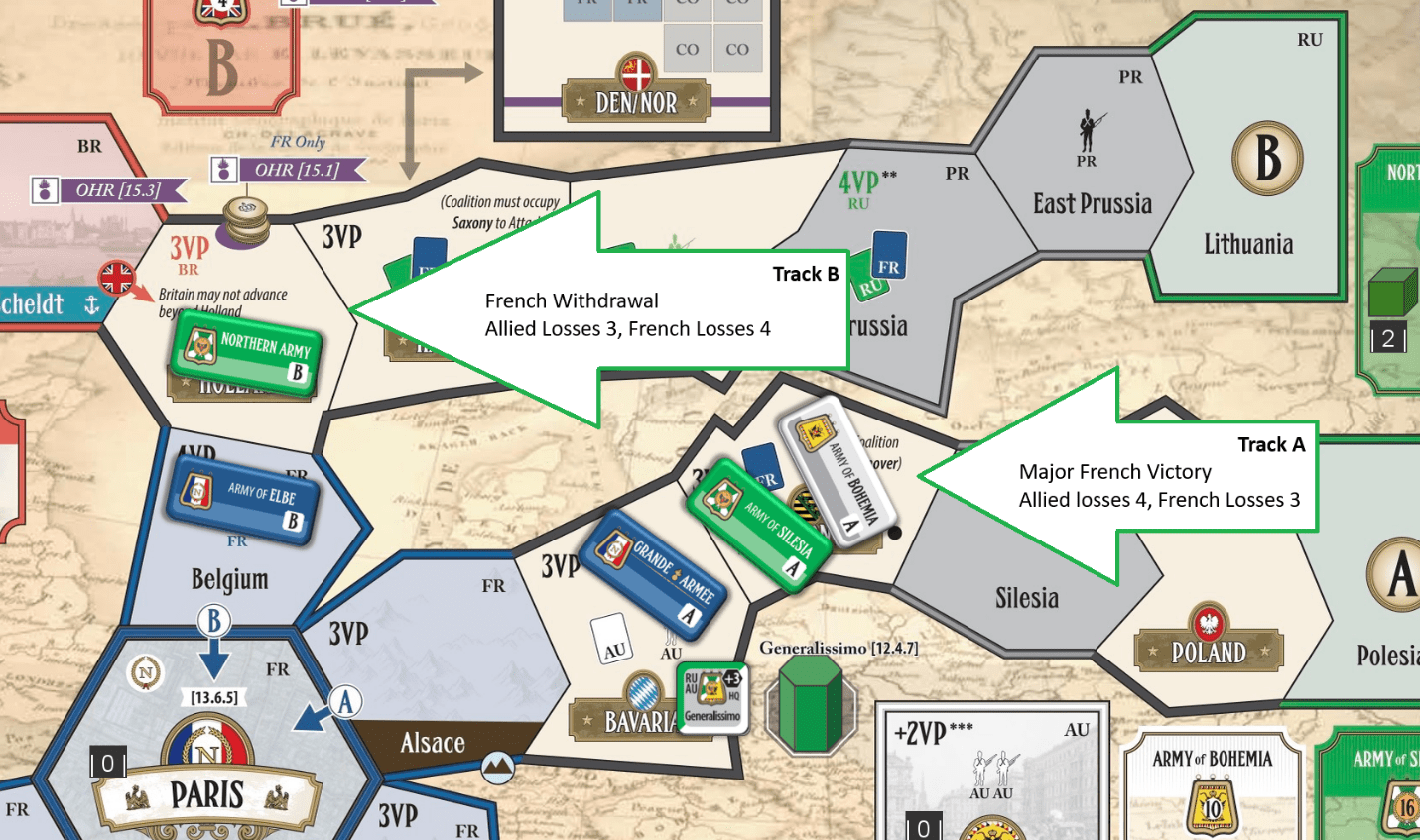
Figure 4: A rebuffed Allied offensive through Central Europe and a startlingly successful French offensive which captures Bavaria. A Russian victory in the North with Holland’s capture!
As you can see from this Figure 3, the French maintain a significant lead in Victory Points. Russia and Austria took it on the chin in Bavaria facing a Bot placed French Military Operation out of Alsace. How confident Frank and I were of victory and defeating Napoleon and Ney in Track A’s Alsace until we realized two “Fog of War” cards remained to be chosen… and the foul fates revealed another French Military Character Card and Battle Card #63, Allied Lack of Coordination, which inflicted a -8DRM upon us (-6DRM for 3 Nationalities: Russian, Prussian, and Austrian with – 2DRM for Napoleon’s presence)!
The VP swing for this Coalition “Bavarian Catastrophe” was 2VP for a Major Battle Victory involving Napoleon and 3VP for Bavaria itself: so it was +5VP for France and -5VP inflicted on each of Russia and Austria.
Thus the Russian Army of Silesia and Austrian Army of Bohemia were smashed and forced to abandon Bavaria to a triumphantly advancing Grande Armée! Oh, the awesome shock of this unexpected result!
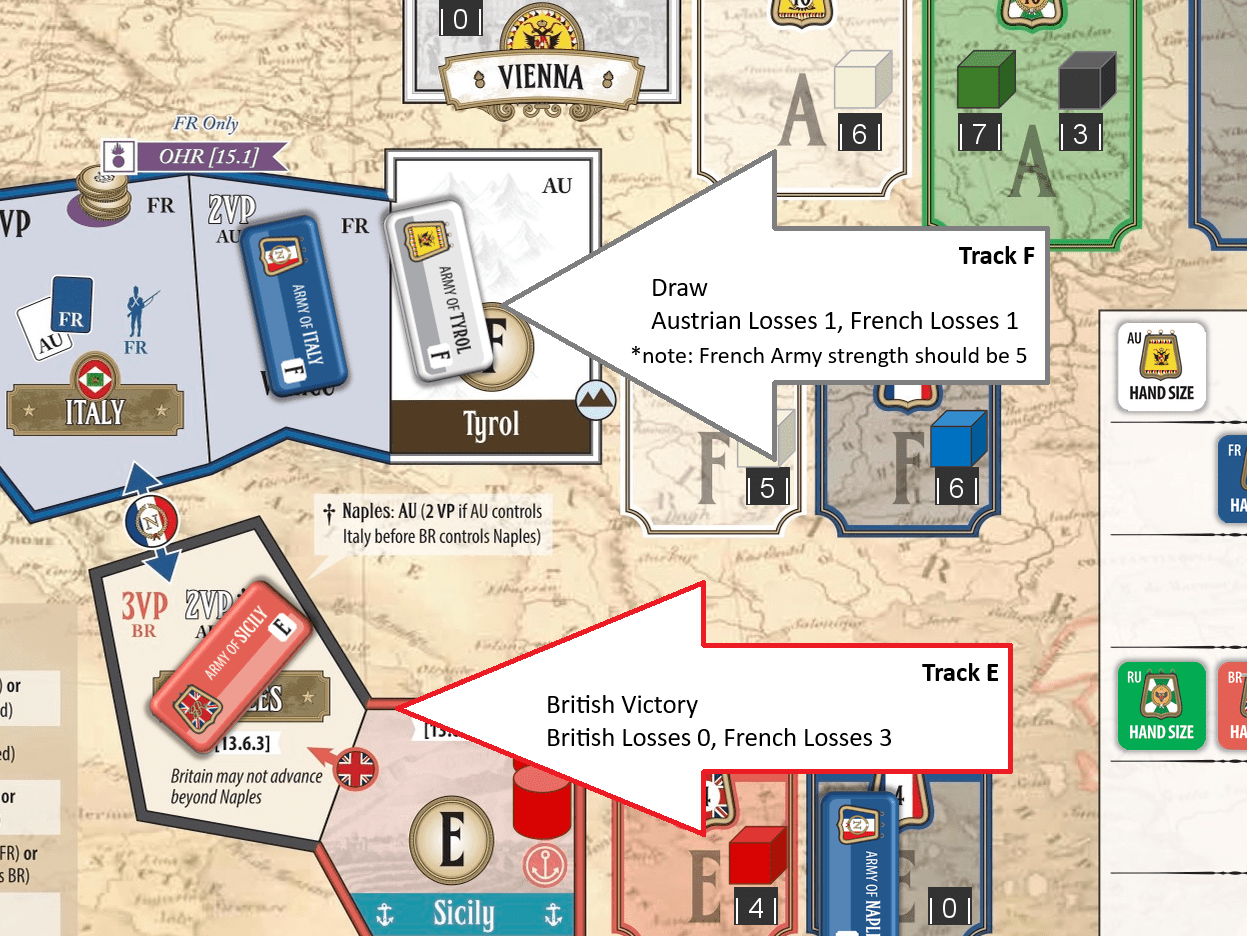
Figure 5: The British thwarted potential Austrian gains by capturing Naples for a +3VP reward, while eliminating the French Army of Naples in a Major Battle for another +1VP. This caused the Army’s remaining units to return to the French Force Pool, as the Army of Italy was already at full strength. The Austrian advance upon Venice stalled.
Nevertheless, David’s Britain did well by capturing Track E’s Naples and eliminating France’s Army of Naples (additionally, since the French Army of Italy was at full strength and unable to accept reinforcement, surviving Army of Naples units had to be placed into France’s Force Pool).
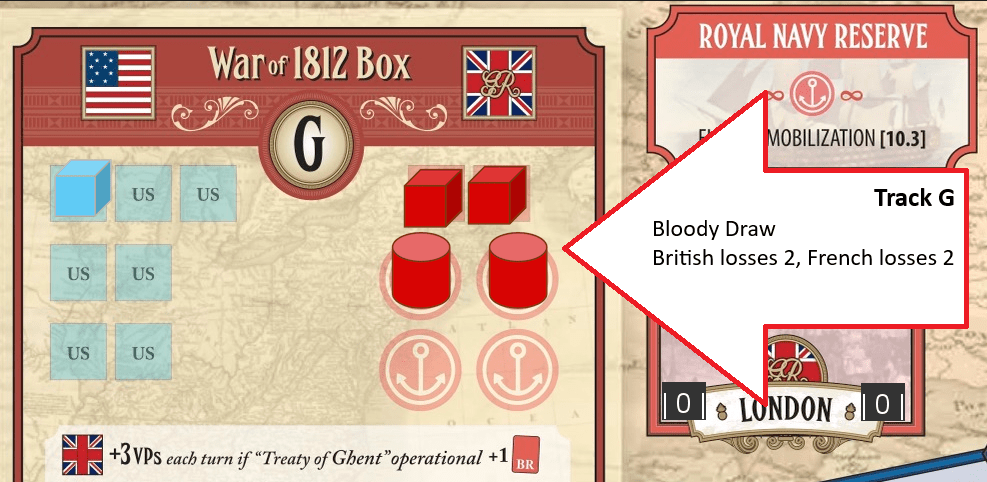
Figure 6: It could have been worse for the British, but this may turn out to be only a minor delay for their ultimate victory in America and the possibility of securing “The Treaty of Ghent” peace.
The final battle of the turn was a British Military Operation for the War of 1812 Box. The result? Thanks to the unexpected presence of the Andrew Jackson Military Card and Tecumseh’s death in battle combined with poor dice rolling, these factors resulted in a War of 1812 Box stalemate.
Since this game has but two official turns remaining, only the Northern Army of Russia, now in Holland as it pursued a withdrawing French Army of Elbe, has any chance of entering the French Paris Homeland Space from Track B’s Belgium unless we play an Optional Turn 11. This may well come to pass.
Britain did not have Wellington to rely on for a push from the South on either Spain Tracks C or D during Turn 1, so maybe Turn 2 will see some positive movement for the Allies regarding those Fronts? That Britain took Naples for itself was simply another poke-in-the-eye to Austria.
Poor Austria (yes, that was me), on its Track F Italian Front attack played four (yes four!) Military Cards to the French Bot’s single Fog-of-War generated card, and, due to abysmal dice rolling, failed to win a victory and advance out of the Tyrol space to capture Venice. Hindsight being 20/20, those Austrian Military Cards may have been better placed to assist Austria’s Track A’s Army of Bohemia and avert the disaster which took place there!
While we still have more testing to do, especially when it comes to the longer scenarios, I believe we are headed in the right direction, as far as providing for multiple human players versus a more challenging French Bot opponent.
Our goal, as testers, is to not add new rules or mechanics, but to make proper adjustments here or there, as needed. In this case, while a new rule was created, it is really a simple adjustment to what would otherwise be on a dedicated Initial Situation Card. Automatically awarding the key French Recruitment Issue to the Bot increases the challenge playing as a team of humans against a more competent French Bot. At least that’s the current indications of this game’s play.
Furthermore, as this report indicates, Congress of Vienna is indeed a game of “luck with the cards and luck with the dice”. But coping with that is no less than what the historic personages had to deal with and is what makes this such a fascinating, fun, challenging and exciting game!
I know that the testers are all looking forward to Turn 2 and the next installment of this game’s After-Action Report.
Previous Congress of Vienna InsideGMT Articles

Author: Justin Penwith
