

By Frank Esparrago
Introduction by Assistant Designer & Editor, Fred Schachter: There is a question posed during many a Congress of Vienna game at club meetings, conventions, as well as within the annals of BGG. The question is this, that while the game is exciting, fun, and full of challenges for the players, is the game balanced between the Major Powers of France, Russia, Britain, and Austria? Does each of these Major Powers provide four players an equal opportunity for victory (particularly the seemingly beleaguered France)?
Within GMT’s Congress of Vienna site, Frank and I offer a series of “How to Play” articles for each of the Major Powers. Here’s the link for Britain’s: How to Play with Each Major Congress of Vienna Game Power: Britain (2024 Edition) – InsideGMT. At its conclusion, links to the other three articles, for Russia, Austria, and France, may be found. There’s also a very well done by A.I. series within BGG addressing the challenges of playing each CoV Major Power. Here’s the link to Britain’s, which leads to the other three presentations: The British perspective on how to play the “Congress of Vienna” | Video | BoardGameGeek.
But these, while hopefully helpful, may not entail sufficient advice. Therefore, Frank here provides his personal perspective and analytical talent, based on playing and/or observing many a Congress of Viennagame to address: How Balanced is Congress of Vienna? With that, take it away, Frank!
Introduction
Over the years, I received many questions about the balance of CoV. I always believed it is balanced between the players of Russia, Britain, Austria and France; but that depends a lot on: A) player conduct (how he or she plays), B) the rest of the players’ strategy, luck, and C) previous CoV experience accumulated by each of the 4 participants. This is a game where an experienced player can have a significant advantage over novices.
An experienced player can usually better cope with the game’s “Luck with the cards / luck with the dice” element. These two factors of fortune are based upon the Napoleonic history the game portrays. For example, how else to explain the inopportune demolition of the sole bridge which stranded a significant portion of the Grande Armée on the wrong side of the river, preventing their retreat, and turning Napoleon’s 1813 Battle of Leipzig retreat from a defeat into an irrecoverable catastrophe (including French Marshal Poniatowski’s death by drowning through achieving his “death die roll” in CoV terms)?
However, in a multiplayer game like Congress of Vienna, it is more difficult to establish a winning percentage for four participants than with a 2-player game.
My perception of how victory is distributed in CoV is that it is not the same throughout all game experiences or, most importantly, through player experience with the game. That is, how many times someone plays CoV to obtain the preceding referenced experiential advantage. The graph below displays victory by Major Power data. I synthesized this based on Eight (8!) years testing Congress of Vienna, first with its many play testers (see the CoV Rulebook’s Credits: thanks to all of you for your much appreciated contributions), and now with new players since the game’s 2025 publication.
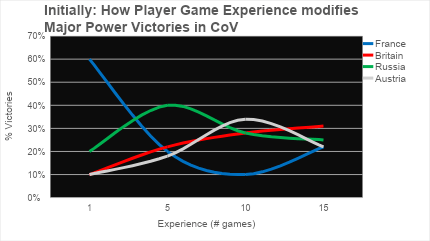
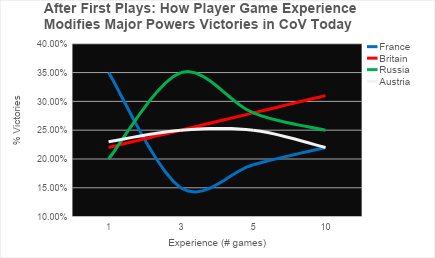
Graph #1: Once CoV’s development and playtesting process was complete and the game published; matters rested in the hands of the players. There was a slight change in Graph #1 due to Allied players becoming much more collaborative: they trade cards, seek common goals, and efficiently remove Issues from the French National Track. Now the gaming experience curve is more like what’s depicted by Graph #2 below.
Let’s now examine these manifestations upon each of Congress of Vienna’s Major Powers:
France
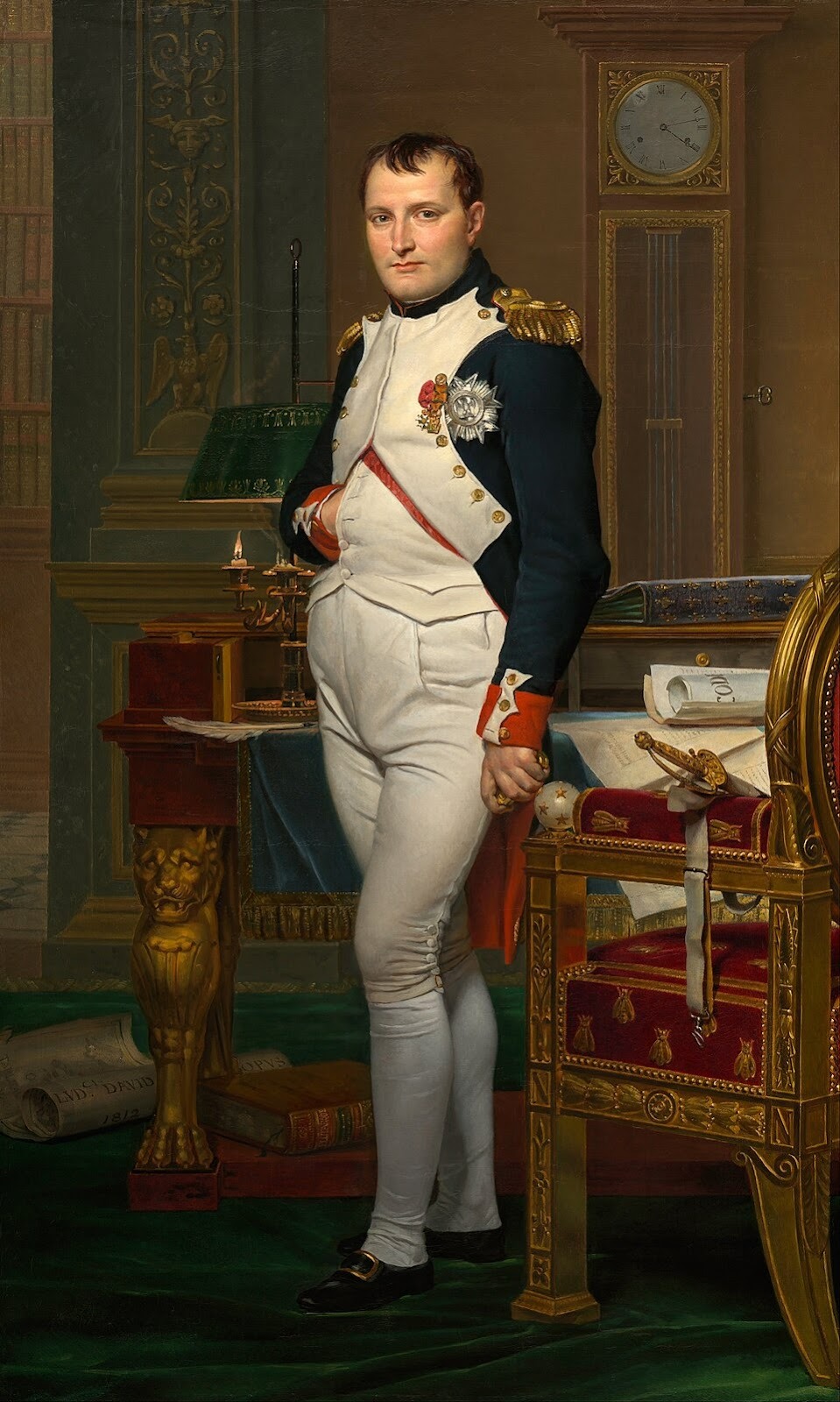
In both graphs we can see how France‘s winning percentage evolves, from more than a 35- 50% range of victories during the first games a group experiences (Vive La France!), to practically non-existent after about 3-5 games played (Woe to France! Who wants to be France next time we play?).
France’s recorded number of victories goes back up when French players’ experience reaches about 10 games. Note how all four Major Powers chances for victory, with 15 games of player experience for each of the four participants, demonstrate game balance by being clustered in both graphs’ 20% – 30% range.
Yes, I know you must be a big fan of a game to play it more than 5 times, but with CoV you have many Issues, cards with different uses (diplomacy, bonus, war) and their related optimal timings to consider. But I believe the effort needed deserves to be made to best appreciate and enjoy the fun challenges of governing a Major European Power at the dawn of the 19th century!
Furthermore, players already familiar with Card Driven System Games similar to Congress of Vienna and/or with GMT’s Churchill in particular, may experience “learning curve acceleration”. There’ll consequently be some talented, bright, veteran wargamer CoV players who can accrue 10 games of graph experience in but 2 – 4 sessions… at least that’s what I’ve observed over the years. If you’re such a veteran gamer, take heart!
The graphs’ depiction of an initial French advantage is the result of two things: the first being the lack of inter-allied collaboration by newbie players. This means that France beats them on quite a few occasions through outright VP victories and in many cases with an automatic game-ending Early Victory through achieving more than 80 VP! This ratio is reduced within Graph #2 because the three Coalition players become painfully aware of the need for inter-Allied cooperation.
After that, usually quickly after the Allied players gain CoV experience (or players are warned about it through their fellow gamers, BGG posts, and/or reading InsideGMT articles), the inter-Allied collaboration situation adjusts. This makes the trading of Allied cards more fluid, resulting in the Russian and British hands becoming filled with military cards that manage to increase their percentage of victories on the battlefield with resultant VPs by seizing VP map spaces and major victories (particularly achieved against Napoleon). When the Allies gain such VPs; they’re often VPs lost by France.
After this, the second factor comes into play when the three Allied players realize that only one of them can win the game. Inter-Allied collaboration relaxes or could become contentious, especially during a CoV End Game, and many times the Future Government of France Issue ends up in the Austrian space, which is not so bad for France. Or neither Britain nor Austria trades the BLÜCHER card to Russia so that the latter does not soar in the race to victory. The same could apply by not trading WELLINGTON to Britain.
This is not solely limited to trades involving military cards. Cards which deliver an additional Resource such as Britain’s 1st BARON ELDON (“The Wig”), Russia’s ARAKCHEYEV, or Austria’s STADION can impede that player’s progress towards victory as could other cards providing bonuses for Issues to a Major Allied Power’s interest.
Furthermore, both Austria and Russia can use the JACKSON or J. BONAPARTE cards to remove a turn’s British VP for Castile, or the War of 1812 turn after turn… That kind of Allied player behavior is behind the Graphs’ rise seen in the recovery of France’s win percentage as French players increase their Congress of Vienna gaming experience.
Does the preceding provide despondent players of France hope that there is a reasonable possibility for the emperor’s survival and French victory? Perhaps it does provide such encouragement.
Russia
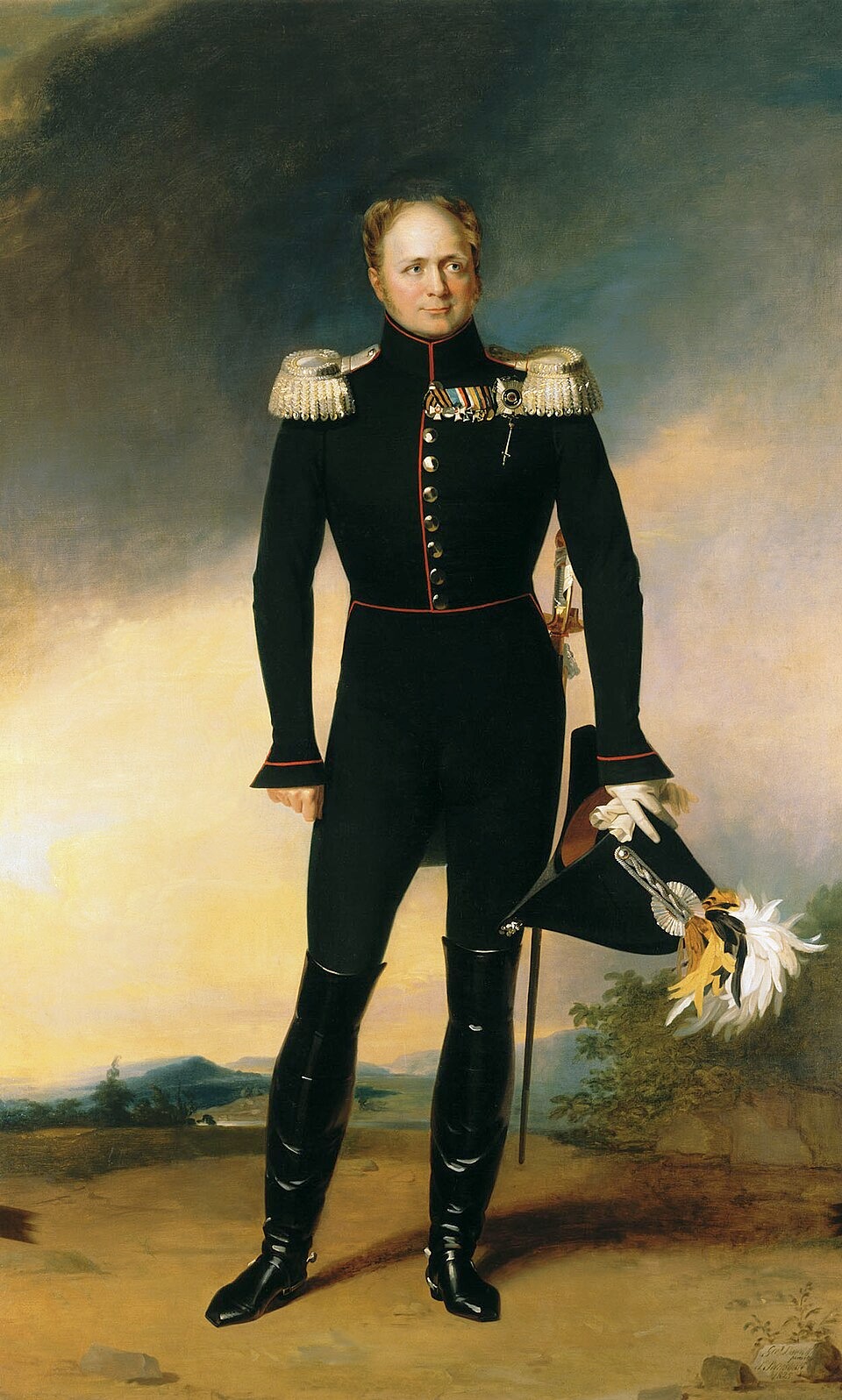
Russia‘s evolution is the opposite of France’s, as Russia’s hand is improved through card trade, Austrian collaboration in the war, and British pressure in Spain and the periphery as well as through Russia winning Absolutism and British Financial Aid Issue[s]. Thus, on many occasions, two Russian armies end up in Paris at the end of a game to be combined with their harvest of VP obtained from their armies’ journey from Poland and East Prussia.
The graphs’ percentage of Russian game victories drops when both Britain and Austria realize that, if they help Russia excessively, it is the Czar who’ll possibly win the game. That’s why I think the victory evolution of Russia is that of a kind of Gauss bell curve with a win maximum after player experience of about 5 games to end up above 20% after the other players obtain more and/or equivalent game experience.
Lack of Resources is the main handicap for Russian VP collection. Therefore, having the ARAKACHEV card and using it for its bonus of an additional Resource is a sought-after boon. If this card is not in your hand, Russia must strive to win British Financial Aid. Put it out for Issue selection if at least one British Financial Aid is not already on the diplomatic board! There’s no point winning a lot of Issues as Russia if you don’t have the Resources to activate them.
Britain
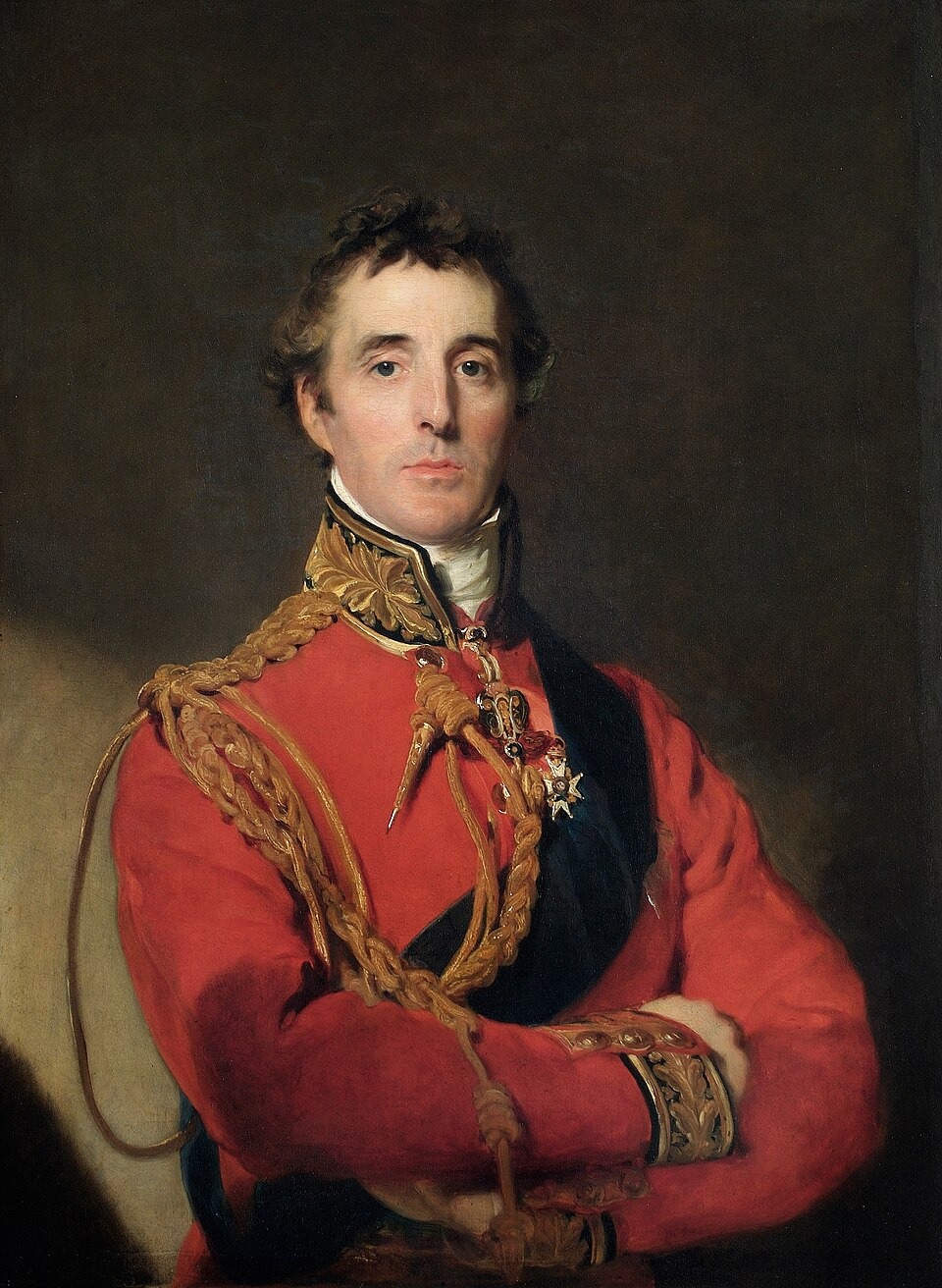
Britain players tend to increase their game win rate with experience, especially when they know, and can therefore exploit, the unique British VP levers such as Pax Britannica, Liberalism, and VPs accumulated through Castile and The War of 1812. Even British Fleet Demobilization can make a VP difference in a close game’s outcome.
Not only does Britain obtain turn by turn VP for holding Castile and 1812, but there are VP opportunities aplenty by capturing Naples while expelling France’s armies from Spain, with related battle victory VP (including a possible VP when a French Army withdraws from WELLINGTON), as well as the potential 10 VP windfall through capturing Toulouse and possibly entering the Paris space!
After playing quite a few games as Britain, complemented by trying the other Major Congress of Vienna Powers to gain appreciation of their respective strengths and challenges, an aspiring British player gets to know all four Powers well and thereby mitigate early learning potential confusion regarding the facets of achieving a British CoV game victory. Britain’s winning percentage in the charts somewhat exceeds 30% for games’ experience. So, while all four Major Powers are balanced by sharing the 20% – 30% bracket… the British have an ever so slight edge. Rule Britannia, eh?
As I already indicated when talking about France, I would like to point out that not only France, but also Austria and Russia should use, always politely and yet with cold courtesy, the below pictured JOSEPH BONAPARTE and/or JACKSON cards to deny British VP for Castile and the War of 1812. In a close game, failing to deny Britain these VP may jeopardize the potential victory of the other two allies. Perhaps, this was what happened historically to the Tsar, when he entered Paris as a victorious hero, yet Britain stole his wallet in CoV terms, being the royal arbiter.

Austria
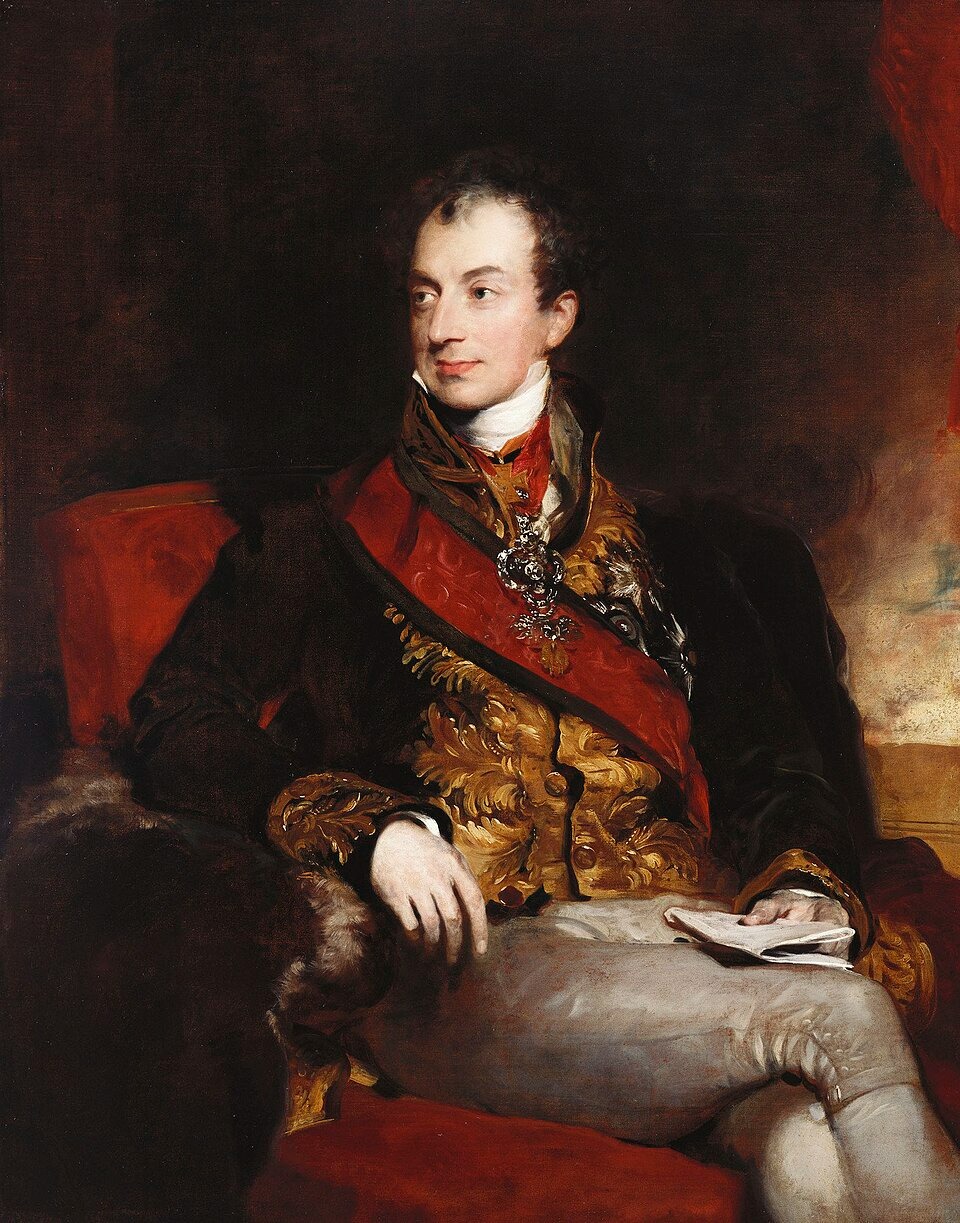
What to say about Austria! She usually goes from a very low win rate to one close to 25% after that player achieves sufficient experience with the game. Having knowledge of the Congress of Peace Issue, (and METTERNICH´s unique skill in playing it), together with hastening the advance on Front A with Russia, gaining the Italian Front Track F’s VP, and fully utilizing Austrian diplomatic skill, allows approaching that 25%.
Of course, like Russia, a lack of Resources is one of the main handicaps for Austrian VP scoring. Therefore, having the STADION card, or receiving it by trade, and using it for its bonus (an additional Resource) is part of standard Austrian play. That is why putting a British Financial Aid into play during Austria’s choice of Issues each turn is a decision to ponder during the early, medium and late games.
But it will always depend on gaining that difficult balance between appeasement, negotiation and battle. However, I think that in a game with experienced, cool of temperament players, who are each capable of “diplomatically stabbing” their fellow players, and taking advantage of any unforced errors, Austria is the Major Power that has the best chance of victory despite what the charts indicate.
The problem is that there are not usually so many cool temperamental players and “diplomatic killers” around the table (or Vassal Screen). It is more common to find types that are more sanguine, spiteful, and sometimes all too focused on the short-term. An effective Austrian player will find it necessary to become like Metternich himself to preserve his opportunity for the Congress of Vienna victory.
Conclusion
I’ve seen too many times allied players who, at the end of a game resulting in France’s defeat and the victory of another Allied player, other than themselves, are satisfied for having seen France defeated… “Hoorah! I’m on the winning team!”. I understand their spirit of collaboration and bonhomie, but the object of this somewhat Machiavellian design is that your power becomes the unchallenged, undisputed winner of a Congress of Vienna game. Strive for THAT!
I hope I have given a few brushstrokes about how elusive victory can seem to players of Congress of Vienna and have managed to dispel any doubts regarding its balance, so as to get you to fully enjoy this game, as much as those of us who created, developed and tested it!
Should the preceding provoke a reader to respond with a question or opinion, feel free to use the “Comments” section below or a BGG post in a related string such as: Can France win? If so, how? | BoardGameGeek. Finally, I conclude by expressing the CoV Team’s gratitude to those who’ve ordered a game of its 2nd printing via: GMT Games – Congress of Vienna, 2nd Printing. Thanks so much for your interest and support!

Author: Frank Esparrago
