

By Russ Brown
Checkpoint Charlie takes place in Berlin, during the period from initial construction of the Berlin Wall in late 1961, up until the summer of 1963. This was a formative period for Berlin and West Germany, and a test of NATO’s resolve. It was also an important period of the Soviet Union asserting its influence over East Germany. Even though most events of the Cold War were much larger in scope and effect than any individual espionage mission in Berlin, I wanted to include some of these events as a way to anchor these missions in time. Checkpoint Charlie includes the sorts of missions that might have occurred during this period, but they are not based on specific historical missions, so I hoped including historical events would help connect the game to the larger narrative of the Cold War. I also thought a game like this would be remiss if it didn’t include significant events that took place in Berlin itself during this period, like Kennedy’s visit and his “Ich Bin ein Berliner” speech, the faceoff of tanks at Checkpoint Charlie, or the prisoner exchange of Rudolph Abel for Francis Gary Powers at the “Bridge of Spies.” It’s worth noting that, as with many CDGs, the events in Checkpoint Charlie are not going to appear in proper chronological order. But, the game spans less than two years, so any of these events could credibly have occurred during any mission.
The events included in Checkpoint Charlie differ from other Card-Driven Games (CDGs) in the way they are played and their effects on the game.
EVENTS JUST HAPPEN
In Checkpoint Charlie, events always happen if they are drawn from the Mission deck. Essentially, they are all mandatory events. They are never held in a player’s hand. Thematically, this is because these events were outside the scope of espionage activities – an SIS case officer in Berlin had no influence over them. The player, as that case officer, just has to deal with their effects on the current mission. Mechanically, there are significant challenges to including playable event cards in the draw area or a player’s hand. These events occur infrequently enough during a mission (see below) that it isn’t worth expanding the rules and creating special cases to give the player a choice. Besides, I didn’t really want to give the player any choice here.
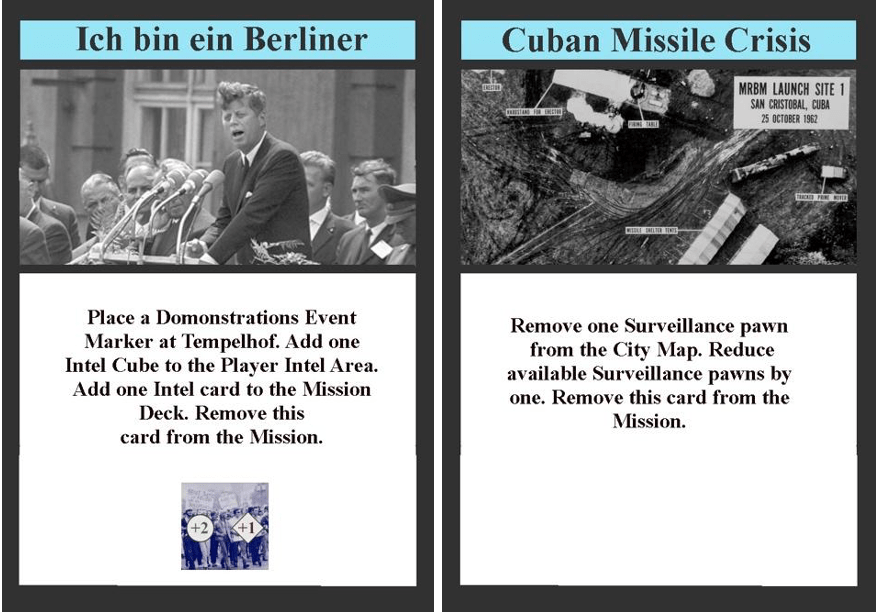
EVENTS EFFECTS ARE OFTEN PERMANENT
Compared to the events in many CDGs, which have an immediate and finite effect on the game state – changing influence here, placing a unit or cube there – events in Checkpoint Charlie often have permanent effects on the mission. They may add cards to the mission deck or place a marker on a location that affects movement or the chances of being detected for the rest of the mission. They change the landscape of the city map and may require some replanning on the part of the player, or they may open up new opportunities. As an example, President Kennedy’s visit to Berlin brings crowds to Tempelhof airfield (represented by a generic Demonstrations marker), and those crowds remain there throughout the mission.
EVENTS EFFECT MISSIONS IN DIFFERENT WAYS
The events of the Cold War often had implications across the world, but this game is only concerned with a single mission occurring over a few days in Berlin. Although the Cuban Missile Crisis brought the whole world to the brink of nuclear war, in Checkpoint Charlie, it just means the KGB is distracted and has reduced surveillance capacity in the city. Kennedy’s famous visit showed the people of West Berlin that the United States and NATO weren’t going to abandon them to be absorbed into East Germany and the Warsaw Pact. In Checkpoint Charlie, in the context of a single espionage mission, Kennedy’s visit just creates crowds at the airport and increases the chances that individual Berliners will share intelligence with the West.
EVENTS ARE LESS FREQUENT
A typical mission in Checkpoint Charlie includes only three or four event cards. This may seem low, but in playtests this felt about right. This works out to one event every five or six turns, and remember that these events always occur when drawn and their effects are usually permanent. Also, if you’ve read the P500 page for Checkpoint Charlie, you may remember that each location, asset and item card has an effect that applies whenever that card is showing in the draw area. These effects are similar to event effects, in that they change the nature of a location on the map or grant some effect or ability to an item or asset. Given that a new effect like this appears in the draw area every turn (and another disappears), the game already has a steady flow of what might feel like events. If a mission included significantly more event cards, they would start to feel like churn, and the significance of each individual event would be reduced.
A LOOK AT SPECIFIC EVENTS
I’ve mentioned President Kennedy and his “Ich Bin ein Berliner” speech and the Cuban Missile Crisis, but it might help to look at the effects of a few other specific event cards.
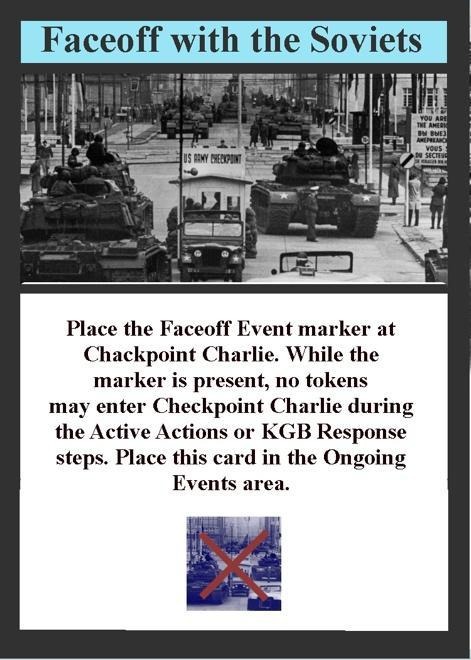
Faceoff with the Soviets: In October of 1961, shortly after initial construction of the Berlin Wall, tensions over access between the two sides of the city led to a faceoff between U.S. and Soviet tanks along the roadway at Checkpoint Charlie. This confrontation lasted only a day, but brought both sides frighteningly close to a battle over Berlin that might have quickly expanded into all-out war. In the game, the faceoff results in a marker placed at Checkpoint Charlie that prevents your assets and KGB agents from entering that location.
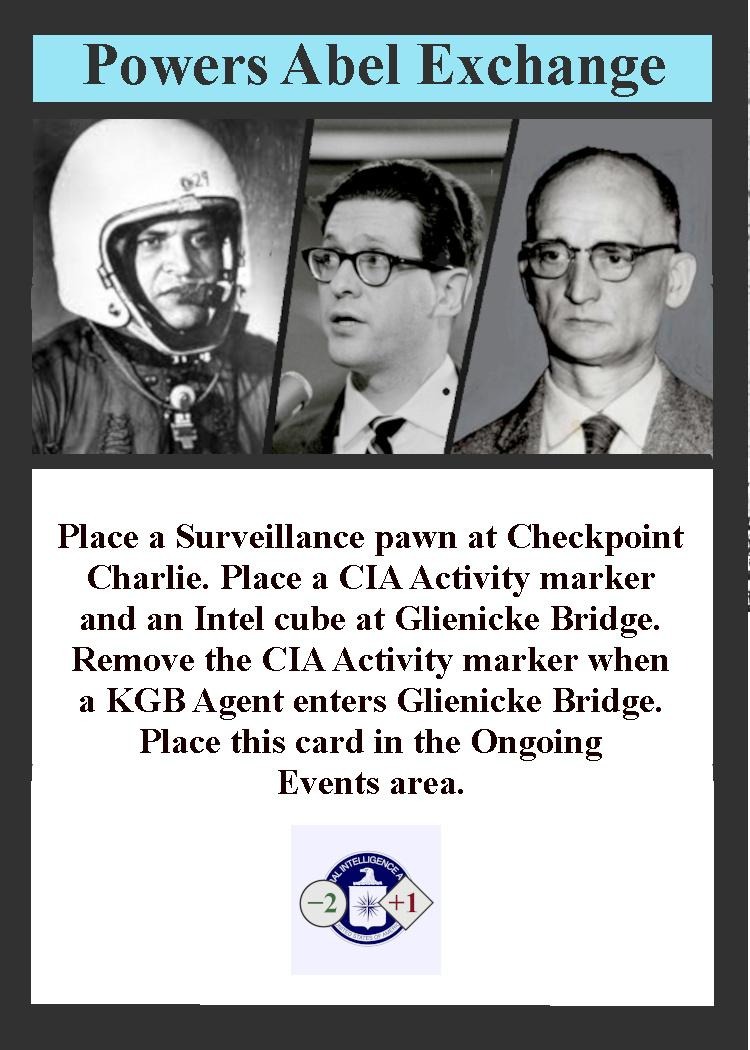
Powers Abel Exchange: On February 10, 1962, at Glienicke Bridge, the CIA exchanged captured Soviet spy Rudolph Abel for Frances Gary Powers, a U2 spy plane pilot shot down by the Soviets. The East Germans also agreed to release U.S. student Frederic Pryor at Checkpoint Charlie at the same time. This is an example of an event linked to espionage activities in Berlin, but because it was primarily an operation of the CIA, not the British SIS, it is merely an event in this game. The effects of this event within the game are placement of a CIA Activity marker and an Intel cube at Glienicke Bridge (representing the intel potentially gained by either side), and a Surveillance pawn at Checkpoint Charlie (representing KGB monitoring of the release of Pryor).
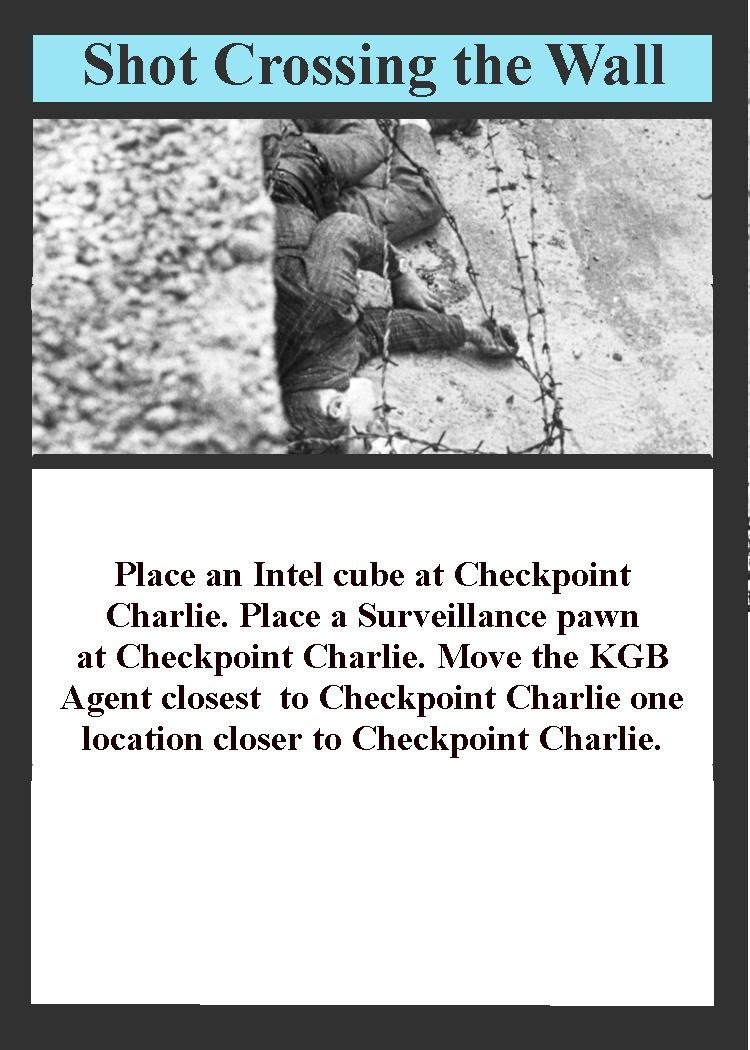
Shot Crossing the Wall: On August 17, 1962, border guards along the Berlin Wall near Checkpoint Charlie shot 18-year-old Peter Fechter while he was attempting to cross into West Berlin. He was left to bleed to death in the no-mans-land between East and West Berlin. This showed to what lengths the East German and the Soviet governments would go to keep people behind the Iron Curtain. Peter Fechter’s death was not an isolated incident, however, just the most publicized. Many people were executed while trying to escape to the West, climbing across the wall or under it through tunnel systems. This is an example of an event card that is placed in the discard pile, so it can recur within a mission, and in the campaign mode of Checkpoint Charlie, it can occur in multiple missions. The game effects of this card are an intel cube and surveillance pawn at Checkpoint Charlie (representing gossip among the gathered onlookers and increased presence of the KGB). This card also moves a KGB Agent one location closer to Checkpoint Charlie as the KGB tries to understand and contain the situation.
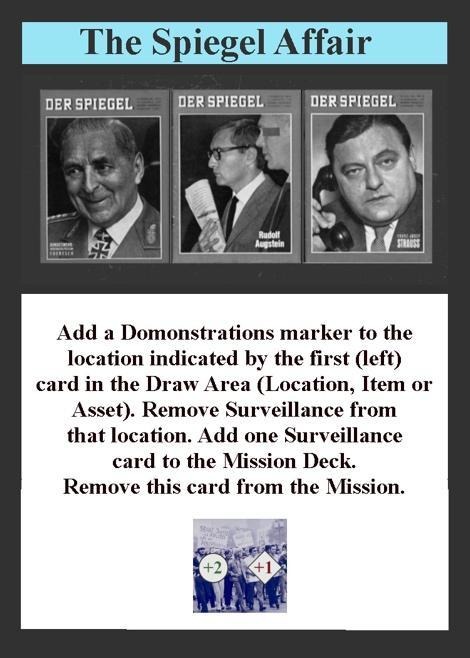
The Spiegel Affair: In October of 1962, the weekly German news magazine, Der Spiegel, published an exposé on West Germany’s lack of preparation for defense, and specifically its poor preparations for defending West Berlin against an incursion by East Germany or the Soviets. It seemed like much of the information had come from anonymous sources within the Defense Ministry. This embarrassed the West Berlin government in Bonn, and they searched the magazine’s offices and arrested the author of the article, intent on charging him with treason. This triggered demonstrations and a larger national debate about freedom of the press and whether West Germany was destined to be a more totalitarian state or a Western-style democracy. The effects within the game are placement of a Demonstrations marker and the addition of a surveillance card to the mission deck, reflecting the increased utility of the West German free press to both East Germany and the Soviets.
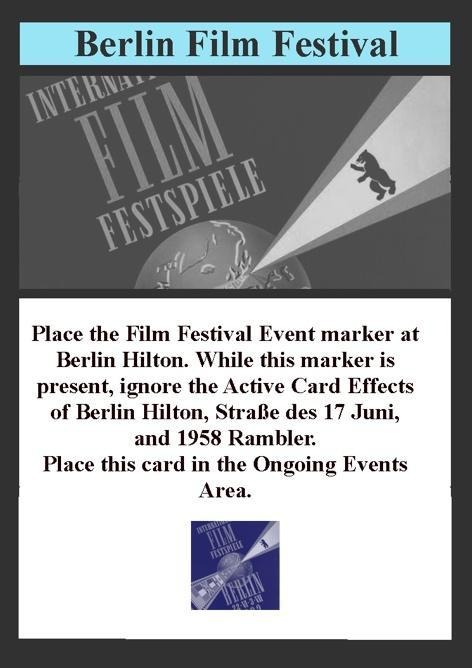
Berlin Film Festival: Despite the disruption caused by the construction of the Berlin Wall the previous year and the growing Cold War tension and danger of Soviet annexation of West Berlin, the annual Berlin Film Festival took place as usual in 1962. It attracted film stars from across the world, including U.S. actors Jimmy Stewart and Tony Curtis. The Film Festival showed that normal life could continue in the divided city and that the world hadn’t abandoned it. In the game, the effects of the festival (which took place at a number of venues around the city over multiple days) are that the Film Festival event marker is placed at the Berlin Hilton, and while it is there, the active effects of three different cards are ignored. This removes the effects of the honey trap in the busy hotel, as well as effects that speed up travel in the city (because of an assumed increase in traffic and celebrity gawkers).
CONCLUSION
Admittedly, Checkpoint Charlie would still function well as a game without the addition of historical events, but I think it would feel more abstract, more detached from any specific time. The events place these missions in a very specific period, and they remind the player of the larger Cold War struggle that was the reason for these missions in the first place. Hopefully, they’ll add to your enjoyment of the game. Join me next time when I talk about player agency in Checkpoint Charlie – how to make the player feel like they have little control when they actually have plenty.


Author: Russ Brown

Very much looking forward to this, but wanted to flag a typo on the Face off with the Soviets card. Chackpoint Charlie.
As a retired US diplomat who served in Berlin, both before and after the fall of the wall, I am very much looking forward to your game. I agree completely on your choice to include more historical events. Especially as we get further and further away from the events and players are less likely to have lived through the events themselves, the historical event cards become more important for understanding the situation on the ground in Berlin.
I think that boardgames is the perfect media for analyzing historical events, incl. the necessary what-ifs.
Also, this game seems perfect for those who always wanted to work for CIA 🙂