

Introduction by ACEA Co-Designer, Fred Schachter: This article’s Part 1 of 2 provided Designer Chris Vorder Bruegge’s general overview, with historical references, of how Ancient Civilizations of East Asia was designed. This included video links readers may find of interest in gaining appreciation of the game’s historical context.
In Part 2 of 2, Author Chris provides a list of ACEA game features which those familiar with the first two games of the “Ancient Civs” Series may find of particular interest. Those games are GMT’s: Ancient Civilizations of the Inner Sea (ACIS) GMT Games – Ancient Civilizations of the Inner Sea, and Ancient Civilizations of the Middle East (ACME) GMT Games – Ancient Civilizations of the Middle East.
So, here’s the conclusion of this piece with a bonus which allows readers to “Meet the Designers of ACEA” and learn of a fun and exciting playtest game, one with five civilizations, they enjoyed along with each other’s company. With that, take it away Chris!
14 New Bonus Features in Ancient Civilizations of East Asia
(Or “What Makes ACEA Stand Out from the Previous Games in the Series”)
The most major changes are presented in alphabetical order.
1_ Commerce
In ACEA, a Civilization may take either a disk or a tael, ACEA’s money, for each other Civilization it is in Commerce with (in ACIS and ACME only a disk may be taken). “Commerce” in all three games is defined when one Civilization’s occupied area is adjacent to another. The more adjacent Civilizations, the more “Commerce” results, so in a 6 Civilization game, a single Civilization would get five (5!) in Commerce: which in ACEA would be any combination of five: disks for Growth and/or tael.
2_ Cultural Development Display Tracks
The Cultural Development Display Tracks were introduced as an optional rule for ACME and could be retroactively applied to ACIS. For a description, see: Optional Cultural Development Tracks for Ancient Civilizations of the Inner Sea (ACIS) and Ancient Civilizations of the Middle East (ACME) – InsideGMT. In ACEA, the Cultural Development Tracks Display is central to the game design. Indeed, advancement on each Culture Track enables a Civilization to reap rewards, perform certain functions, and even instantly win the game via a Mandate of Heaven victory.
Mandate of Heaven: As previously stated, a Civilization can win automatically if it achieves, before all others, the highest level of development on all three of the Culture Tracks (Military-Political; Economic-Social; and Religious-Intellectual). If interested in learning more, check out this short, under five minute video. It reveals how the ancient Chinese people, in face of a myriad of miseries, would reject one set of rulers for new ones: “Mandate of Heaven: Political Excuse Behind China’s Dynastic Revolving Door!”#fun ##history #myths
3_Great Building Projects – The Great Wall and Grand Canal:
Great Wall: If a Civilization can build enough Strongholds in more contiguous areas than other Civilizations, it can declare a Great Wall. But there can be only one Great Wall in effect at a time. If another Civilization builds a longer one, then that Civilization claims the title. Having the Great Wall impedes Barbarian Invasions and reaps VP.
Grand Canal: Similarly, if a Civilization builds enough contiguous irrigation projects, represented in the game by Terrace/Improved Irrigation System counters, and has more of them than other Civilizations, it can declare a Grand Canal. Again, there can only be one at a time, but depending on the vagaries of nature and the actions of other Civilizations, that title might pass to another player. Having the Grand Canal provides the owner with VP and either disks or tael. It is a fine generator of wealth!
4_Homelands
In ACIS there are 10 Homelands, one per Civilization. In ACME there are 20 Homelands and 16 Civilizations. ACEA has 19 Civilizations with most of them able to relocate their Homeland. Yes indeed, most ACEA Civilizations have the option of changing their Homeland area during a Card Phase.
-In ACIS, Civilizations have their Homeland locations identified on the game map.
-This is not the case with ACME. Each Civilization has its Homeland, in some cases only a single location, in others the player has a choice between 2 or 3 locations. For Ancient Civilizations of East Asia, each Homeland is indicated on the back of its Civilization Display as well as within appropriate pages of the Rulebook and Playbook.
-Unlike ACIS, in both ACME and ACEA a Homeland is designated by placing the Civilization’s colored block upon a preprinted map location.
5_ Karma Cards and Card Phase
Although most of the card types of ACIS and ACME are included in ACEA, a new one is introduced. That new card type is identified as “Persistent” (Coded with a letter “P”). It is unique to ACEA in allowing the specified “P” card’s good or ill effects to possibly endure for more than a single turn. Unlike ACME, ACEA does not have Investment cards for “Oasis”, “Fishing Grounds”, and/or “Mountain of Gold”.
During a Card Phase, as with ACIS and ACME, a Civilization can choose between one of three options: 1_ Play a Card, 2_Acquire or do something for Resources (in ACIS this is acquiring a “Wonder” and in ACME it is a “Deity”), or 3_Pass.
In ACEA, option 2 presents a player with far more choices (seven of them!). These include 1) Declare a Philosophy (initial acquisition is two Resources; to change costs four Resources) or, 2) With the needed prerequisites, Purchase an advance on one of the Cultural Development Display’s Tracks, or for two Resources build in an allowed Controlled area: 3) a Stronghold, 4) Workshop, or 5) a Terrace/Improved Irrigation counter, and if possible, declare the Grand Canal and/or Great Wall (if criteria met), 6) Change the Civilization’s Homeland location by moving its block to one of its Controlled Land areas, or finally, 7) Culturally Absorb a Land area’s black disk(s) through discarding a card of choice from the player’s hand. The player must have at least one Controlled Land area adjacent to the area being “absorbed”. This results in the area’s black disk(s) replacement by one disk from Supply of the card playing Civilization: The history of China is one of invaders winning the land but the culture absorbing the victors.
Bribing Barbarian Invaders! In ACEA, players can “bribe” barbarians when a Barbarian Invasion “Must Play” Event card is revealed and thus reduce the potentially devastating effects of those pesky black barbarian disks. Just as during antiquity, a rich Civilization is often a safer and more secure Civilization… at least until the money runs out (or tael in ACEA’s case).
6_ No “Breath of God” Event Card
Many players of Ancient Civilizations of the Inner Sea and Ancient Civilizations of the Middle East did not like this Event card as it forced players to discard their sometimes hard earned or eagerly anticipated to play card hands and replaced them with four new cards. There were even some who agreed to a House Rule to remove this Event card from the deck before commencing play. The ACEA Design Team, in response, made certain there’d be no Ancient Civilizations of East Asia “Breath of God” card!
7_ No Card Set-Asides or Reshuffles
Unlike ACIS and ACME, there are no cards that require being set-aside or needing to be reshuffled into the Draw Deck. There are two ACEA Karma cards which precipitate shuffling the Discard Pile into the Draw Deck: Negate card #30, Confusion Reigns and Event card #105, Time Marches On. That’s it!
8_ No Offsetting a Disk’s REPLACEMENT via Expending a Tael from Treasury or Card from Hand
ACIS and ACME allow a Civilization to “buy-off” (cancel) through expenditure of a talent/mina from its Treasury, or a card from its hand, a disk threatened by Removal or Replacement. That remains true in ACEA if Removal is involved. But due to a more devious and volatile political climate, that’s not so in cancelling a disk’s Replacement with ACEA.
In ACEA, stopping Replacement of a disk is only possible if a player possesses Great Person Negate Card #18, Dowager Empress, who can reduce by two the Replacement of an area’s disks as well as outright negate a “P” card such as a Peasant Revolt, Tax Revolt, or Dynastic Crisis. Yup, it can be a superb asset having the Dowager Empress card’s soothing influences in your hand during a Card Phase!
9_ Non-Urban Nomad Civilizations
Unlike ACIS and ACME, where every Civilization can benefit from Cities (stacks of three disks or more), ACEA has two Nomad Civilizations: the Xiongnu, who are to the Chinese heartland’s north, and the Peoples from the Sea, whose Homeland is in what is today Indonesia. These two Civilizations reap victory points and treat the Cultural Development Tracks Display differently from their urbanized counterparts. They can’t have Cities! These two Civilizations ignore the Cultural Development Tracks Display and do not participate in it! They ignore Change of Epoch Table Event results involving Cities: e.g. “Urban Decay”.
After gaining familiarity with the game’s more “traditional” Civilizations, we’ve had play testers who thoroughly enjoy these Nomad Civilizations’ challenges and single-minded aggressive focus… which causes contention, but a lot of gaming fun!
10_Philosophy
Instead of deities as in ACME, ACEA allows each Civilization a generic choice of one of three Philosophies: Traditionalism (think Buddhism, Confucianism, Taoism, Shintoism, ancestor worship, etc.), Legalism (think moral law or code rather than personal religious faith) or a Traditional-Legalism hybrid of the first two. Each Philosophy offers different benefits and can be changed each turn, once a Civilization has reached a certain level on the related Culture Track and is willing to pay the needed Resources or is fortunate in receiving a card allowing a FREE change/adoption.
11_Resources
As with ACIS and ACME, a Resource is a card from hand, money (a tael in ACEA), or a disk from the map… but in ACEA the disk removed may not be the only disk in an area.
12_Strongholds
More of them! Instead of limiting Strongholds to Mountain areas, which are free to each of a Civilization’s Controlled Mountain areas, Civilizations, at a cost of two Resources each, can build them anywhere. A Stronghold, in all 3 “Ancient Civ” games, is the equivalent of a disk and is removed first during a Competition after any of that Civilization’s white disk[s] are removed.
13_Terracing/Improved Irrigation Systems: Civilizations can improve Mountain areas with terracing and other areas with irrigation improvements. Once a Civilization achieves the needed Cultural Level, these may be built in any Controlled areas except desert. A Terracing/Improved Irrigation System small gold star on one side green square counter increases income: a disk each Growth Phase. These are used to declare The Grand Canal (see #3 above).
14_ Workshops: Civilizations, if permitted by their Economic-Social Track counter’s advancement, may invest in Workshops, represented by small gold starred on one side grey hexagon counters. These may be placed in controlled land areas with a Civilization’s Cities and boost productivity in the form of tael (money) for those occupied Citified areas having Workshops (think silk, porcelain, weapons, etc.). One tael per Workshop for each of a Civilization’s occupied City areas is a nice source of income!
Closing Remarks by ACEA Co-Designer, Fred Schachter: Does the preceding strike a chord of interest to your gaming heart? The Ancient Civilizations of East Asia Design Team hopes so. In conclusion, here’s a photo of the team… your fellow gaming aficionados!
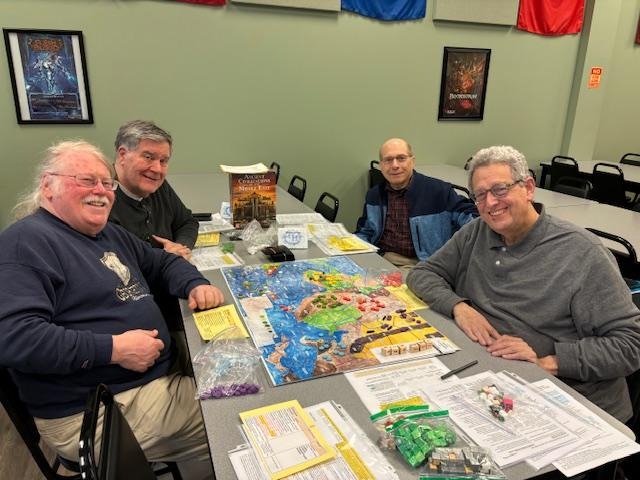
The above photo is of a five-player Ancient Civilizations of East Asia play test game, using the prototype mentioned in this article’s Part 1 of 2, as it was set-up at Huzzah Hobbies in Virgina, a central location for the game’s three designers to meet and promote the game during a long weekend of ACEA fun.
This was a “Sandbox” game which deliberately left the seven valuable light green Fertile areas of the China Heartland completely open for grabs by four of the five Civilizations immediately surrounding it. What negotiations THAT precipitated! The white disks define the map’s abbreviated playing area thereby creating something of a “Steel Cage Match”… which is just the way we like it!
Not shown is Rich, the photographer, who was playing the nomadic Xiongnu in the yellow Desert areas north of the China Heartland. Note how their initial placement purple disks already control some of the long-black Silk Road pieces for toll gathering purposes. The Xiongnu don’t have Cities nor use ACEA’s Cultural Development Tracks but get their Victory Points in other ways. Wanna guess how?
The four pictured players about the table took the roles of traditional Ancient Civilizations of East Asia Civilizations, which would be familiar to players of the game’s two series predecessors: Ancient Civilizations of the Inner Sea and Ancient Civilizations of the Middle East, save that with ACEA they all have the option and design encouragement to use the Cultural Development Tracks Display.
To the photo’s left is Designer Mark McLaughlin, playing the blue disk Korea. Next to Mark is Designer Chris Vorder Bruegge taking the role of the Green Disk Chu. Across the table from Mark is Designer Fred Schachter commanding the Red Disk Zhou and seated next to Fred is his long-time buddy from youthful days of wargaming in the Bronx, Ollie, who is playing the Yellow Disk Southeast Asian Jungle based Dong Son Civilization.
Ah, what a game it was! Thank you for your interest in Ancient Civilizations of East Asia.

Author: Christopher Vorder Bruegge
